
BELL’S MIRROR
Derrick Bell’s Critical Race Theory and the Architecture of Exclusion in 2013–2026 America. Was he right?

Architecture of Inclusion Series
By Effenus Henderson
A NOTE BEFORE WE BEGIN
Did Bell Have It Right?
I did not think Derrick Bell could be right.
That is the honest place to begin. I have spent thirty years in this work — building frameworks, writing books, training leaders, designing systems — animated by the belief that the architecture of inclusion was not just necessary but possible. That organizations, institutions, and governments could be intentionally redesigned to expand human possibility rather than constrain it. That the arc, as Dr. King promised, bent toward justice. That the work we were doing was permanent work. That we were building something that would last.
Derrick Bell did not share that confidence. He said, with the quiet precision of a man who had watched the law fail his people across decades, that racism was not a wound that America was trying to heal. It was a feature it was trying to preserve. He said that civil rights progress happened not because justice prevailed but because the interests of those in power briefly aligned with the interests of those seeking equality — and that when those interests diverged, the progress would be taken back. He called this interest convergence. He was not bitter when he said it. He was clear.
I disagreed with him. Respectfully. Hopefully. Perhaps naively.
And then came 2025.
In the span of a single year, I watched Executive Order 11246 — the sixty-year-old foundation of affirmative action in federal contracting, signed by Lyndon Johnson in the long shadow of Selma — rescinded by a stroke of a pen. I watched every federal DEI office shuttered, every open discrimination investigation closed, every OFCCP enforcement officer ordered to stand down. I watched the Supreme Court hand down Louisiana v. Callais on April 29, 2026, rendering Section 2 of the Voting Rights Act, in Justice Kagan’s own words, ‘all but a dead letter.’ I watched Haitian immigrants — descendants of the first free Black republic in the Western Hemisphere — stripped of their protected status and funneled toward deportation without adequate notice, without counsel, sometimes without hearings. I watched legislation introduced in the United States Congress titled, without apparent shame, the DEI to DIE Act.
And I found myself, in the silence after reading each of these things, returning to Bell.
“I did not want him to be right. But wanting him to be wrong did not make it so.”
— Effenus Henderson
The question I am sitting with — the question that prompted this essay — is the one I have been avoiding for the better part of two years: Did Bell have it right? Not partially. Not in some abstract academic sense. Fully. Fundamentally. In the way that only a prophet is right — which is to say, in the way that costs something to admit.
I think the answer is yes. And I think the more important question is what we do with that yes.
Bell’s Racial Realism was not a counsel of surrender. It was a demand for a different kind of courage — the courage to see clearly without being destroyed by what you see, to keep building without the comfort of believing the building will never be torn down. He kept writing. He kept teaching. He resigned from Harvard — twice — rather than compromise what he knew to be true. He did not wait for the arc to bend on its own. He put his hands on it.
What follows is my attempt to do the same. It is an accounting. A reckoning with Bell’s mirror held up to 2026. It is written in grief and in fury and in the stubborn, clear-eyed commitment that has always been the only honest response to the architecture of exclusion: you name it, you document it, you refuse to look away, and then you build.
You build anyway.
“The real question is not whether the law can be used to achieve racial justice, but whether those in power have the will to use it — and history suggests they never do for very long.”
— Derrick Bell, Faces at the Bottom of the Well (1992)“Today’s decision renders Section 2 all but a dead letter. In the States where that law continues to matter — the States still marked by residential segregation and racially polarized voting — minority voters can now be cracked out of the electoral process.”
— Justice Elena Kagan, Dissenting, Louisiana v. Callais (April 29, 2026)“DEI is not the defect. Exclusion is. And when powerful systems erase the remedy, they are not restoring neutrality. They are reinstating the disease.”
— Effenus Henderson, DEI Is Not the Defect — Exclusion Is (2025)
I. RETURNING TO THE PROPHET
I have spent the better part of three decades building what I call the Architecture of Inclusion — the deliberate, measurable, structural design of systems that expand rather than constrain human possibility. I have trained thousands of leaders, written frameworks, developed standards, and stood in the rooms where decisions were made about who gets to belong and who does not.
But before I stood in those rooms, I stood on the roads of rural eastern North Carolina. And the roads taught me everything I needed to know about the architecture of exclusion long before I had a name for it.
And yet, in the winter of 2025, I found myself returning — with something between grief and grim recognition — to the work of Derrick Bell.
Bell died in 2011. But he seems to have been writing about 2025. And about April 29, 2026.
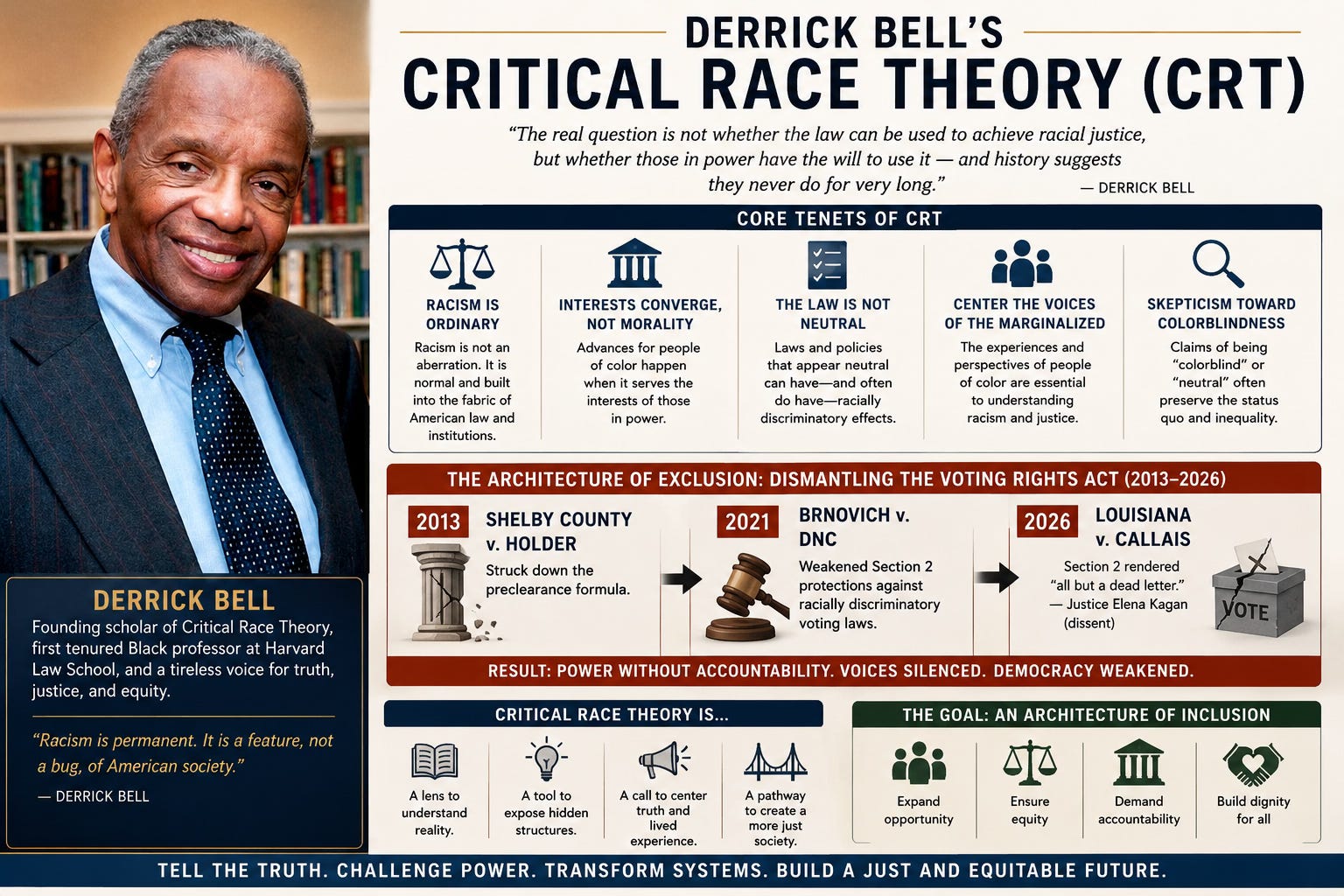
Professor Bell — the first tenured Black professor at Harvard Law School, who twice resigned prestigious positions on principle rather than betray his convictions — was the founding architect of Critical Race Theory. Not the cartoon version that Christopher Rufo deliberately poisoned as a political weapon beginning in 2021. The real thing: a rigorous, evidence-based legal and sociological framework asserting that racism is not an aberration in American law and society. It is the architecture. It is the foundation. It is the load-bearing wall.
What follows is my attempt to hold Bell’s mirror up to the present moment — to name the parallels between what he foresaw and what we are living, and to situate them within the framework of the Architecture of Inclusion I have spent my life building, and which powerful forces are now spending considerable energy trying to dismantle.
I want to be plain. I want to call things by their names. Bell was plain. He was uncomfortable to read because he refused to soften the truth into something more palatable. This essay follows that example.
II. THE SCAFFOLD: HOW THE ARCHITECTURE OF EXCLUSION IS BUILT
The Architecture of Exclusion is not built in a single moment. It is assembled across time, through a series of structural decisions — legal, legislative, executive, judicial — each of which, in isolation, can be defended on its own terms. What matters is the cumulative blueprint. What matters is what the building looks like when you step back and see the whole thing.
Bell understood this. He did not spend his career pointing at individual bad actors. He mapped systems. He asked: what are the load-bearing walls of American racial hierarchy, and what happens when you try to remove them? And more importantly: what happens when the people with power to keep them standing also have the power to stop you?
In 2026, we can now see the full scaffold of the current moment. It spans more than a decade. It runs from the Supreme Court to the White House to the halls of Congress. And it is, unmistakably, a design.
III. THE THREE BLOWS: DISMANTLING THE VOTING RIGHTS ACT
The Voting Rights Act of 1965 was, as Justice Elena Kagan has written, the product of ‘awe-inspiring change.’ It was won at Selma. It was purchased with blood on the Edmund Pettus Bridge. It was the most important civil rights legislation ever enacted — not because it was eloquent, but because it actually worked. It changed who could vote. It changed who could represent. It changed who had power.
It has now been rendered — in Kagan’s precise words, issued from dissent on April 29, 2026 — ‘all but a dead letter.’
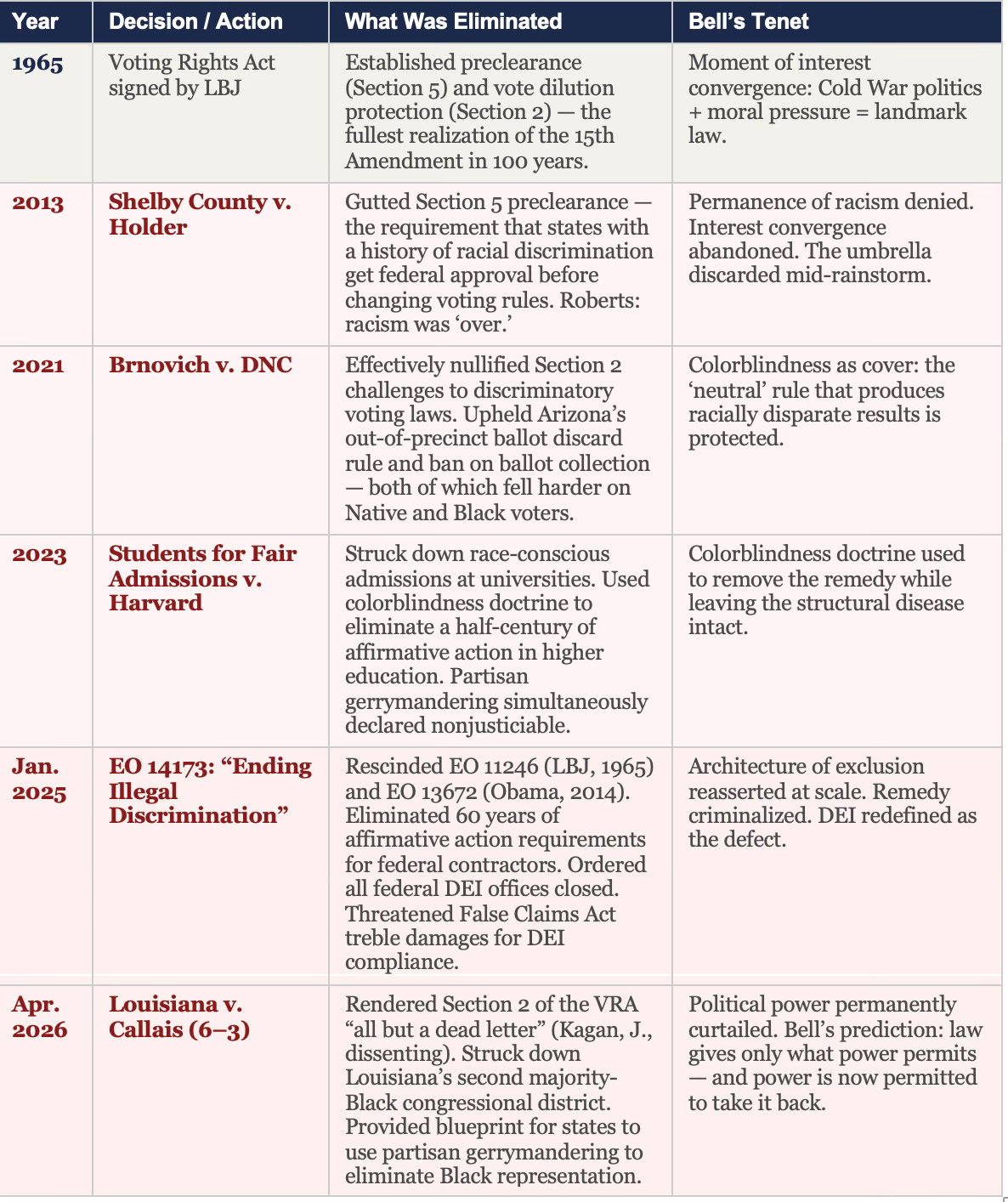
This did not happen overnight. It happened in three blows, across thirteen years. Each blow was authorized by the Supreme Court. Each was framed in the language of constitutional fidelity. Each, in effect, dismantled a pillar of the architecture of inclusion that generations had bled to build.
The First Blow: Shelby County v. Holder (2013)
WHAT IS PRECLEARANCE?
Preclearance was the enforcement mechanism at the heart of the Voting Rights Act of 1965. Under Section 5 of the Act, any state or locality with a documented history of racial discrimination in voting — originally covering most of the Deep South, plus parts of other states — was required to obtain advance approval from either the U.S. Department of Justice or a federal court in Washington, D.C., before making any change to its voting laws, procedures, or district maps.
The key word is ‘advance.’ A state could not close polling places in Black neighborhoods, redraw district lines to dilute Black votes, or change voter ID requirements and then wait to be sued after the damage was done. It had to prove, before the change took effect, that the change would not make things worse for minority voters. The burden of proof was on the state, not on the voters. This is what made preclearance so effective — and so threatening to those who wanted to change voting rules without scrutiny.
Think of it this way: preclearance was the building inspector who showed up before the building was occupied, not after the ceiling had already fallen. Shelby County sent the inspector home. The buildings that followed have been collapsing on the same communities ever since.
Between 1965 and 2013, the preclearance process blocked thousands of discriminatory voting changes — polling place closures, voter purges, district maps designed to fragment Black political power, and more. Justice Ginsburg’s dissent in Shelby County noted that between 1982 and 2006, the DOJ had objected to more than 1,000 proposed voting changes in covered jurisdictions. Those objections never had to become lawsuits. The threat of preclearance was itself the deterrent. When preclearance was gone, the deterrent was gone.
Chief Justice John Roberts, writing for a 5-4 majority, suspended Section 5 of the Voting Rights Act — the preclearance requirement that states with a documented history of racial discrimination obtain federal approval before changing their voting rules. His reasoning: the racial turnout gap had narrowed. In 2008 and 2012, Black and white voter turnout had reached near-parity. Racism in elections was, effectively, ‘over.’
Justice Ruth Bader Ginsburg, in dissent, offered the umbrella metaphor that has since become prophetic: ‘Throwing out preclearance when it has worked and is continuing to work to stop discriminatory changes is like throwing away your umbrella in a rainstorm because you are not getting wet.’
The rainstorm that followed has been documented with precision. Since 2013, the racial turnout gap has expanded. Multiple states previously covered by preclearance — including Texas, Georgia, Alabama, and North Carolina — immediately moved to restrict early voting, close polling places in predominantly Black counties, tighten voter ID requirements, and redraw district lines that had protected Black representation. In Galveston County, Texas, a white Republican majority voted in 2021 to redraw Precinct 3 — splitting Black and Hispanic voters who had, for 30 years, been able to elect candidates of their choice — into majority-white districts. No federal approval was needed. The umbrella was gone.
Research from the Brennan Center demonstrates that since 2013, the very trend that the Shelby County majority cited to argue things had changed — the shrinking gap in turnout between white and Black voters — has now reversed. Much of the increase in the turnout gap was caused by the Shelby County ruling itself.
— Brennan Center for Justice, Growing Racial Disparities in Voting (2024)
Bell would have recognized Shelby County immediately. It is a textbook example of his most challenging claim: that civil rights protections are withdrawn when they are no longer useful to those in power. The VRA was useful during the Cold War — Jim Crow was an international embarrassment. It was useful during the long decades when its enforcement built a political coalition that benefited from its existence. And then, when the political calculus shifted, it was declared no longer necessary — at precisely the moment when ‘no longer necessary’ meant ‘no longer politically convenient for those who benefit from its absence.’
The Second Blow: Brnovich v. Democratic National Committee (2021)
Eight years after Shelby County gutted Section 5, the Court turned its attention to Section 2 — the provision that allows after-the-fact challenges to voting laws that produce discriminatory results. Shelby had removed the pre-approval requirement. Brnovich largely eliminated the meaningful ability to challenge discriminatory laws after they took effect.
The case involved two Arizona policies: a rule discarding ballots cast in the wrong precinct even for elections in which the voter could have voted anywhere in the state, and a criminal statute banning anyone other than a family member or caregiver from returning another person’s mail-in ballot. Both policies fell disproportionately on Native American, Black, and Latino voters. The Supreme Court upheld both, rewriting the evidentiary standards for Section 2 challenges in the process.
The architecture was now clearer. Discriminatory intent is nearly impossible to prove. Discriminatory impact can be documented in painstaking detail — and still be insufficient. The remedies available to challenge racial discrimination in voting had been systematically narrowed to the point where they existed in name only.
The Third Blow: Louisiana v. Callais (April 29, 2026)
On April 29, 2026 — two weeks before I am writing these words — the Supreme Court issued its decision in Louisiana v. Callais. By a 6-3 vote, split entirely along ideological lines, Justice Samuel Alito wrote for the majority.
The case was, on its surface, about Louisiana’s congressional map. But beneath the surface, it was about whether the Voting Rights Act’s Section 2 — the last major provision left standing after Shelby County and Brnovich — could be used to require states to create districts that gave Black voters a meaningful opportunity to elect candidates of their choice.
Louisiana had, under court order and after years of litigation, redrawn its congressional map to create a second majority-Black district. Black voters in Louisiana — who represent over 30% of the state’s population — had, for the first time in history, elected two Black representatives to Congress. Then a group of voters who described themselves as ‘non-African American’ sued, claiming the map was an unconstitutional racial gerrymander.
The Court agreed.
Today’s decision renders Section 2 all but a dead letter. In the States where that law continues to matter — the States still marked by residential segregation and racially polarized voting — minority voters can now be cracked out of the electoral process.
— Justice Elena Kagan, Dissenting, Louisiana v. Callais (April 29, 2026)
The decision provided an immediate blueprint. Tennessee Republicans moved within days to eliminate the state’s sole majority-minority House district. Florida passed a redistricting bill the day the decision was announced. Alabama filed an emergency motion to reinstate a legislature-drawn map that a special master had replaced under Allen v. Milligan — arguing that Callais overrode Allen entirely. State after state is now reading Callais as a green light to crack Black voters out of electoral districts under the cover of ‘partisan’ justifications that cannot be disentangled from racial ones.
Justice Kagan, in her dissent, offered the clearest historical accounting: Shelby County made a nullity of Section 5. Brnovich did half of what was needed to raze Section 2. Callais finished the job.
I read Kagan’s dissent and hear Bell’s voice. He said this would happen. He said the law gives communities of color only what power permits them to have — and that power, when its interests shift, finds a way to take it back. He would not have been surprised. He would have been exactly as furious as Justice Kagan. And he would have kept building.
The table below maps the full arc of this dismantlement:
IV. THE EXECUTIVE ARSENAL: NAMING WHAT WAS TAKEN
The Supreme Court moves slowly. Executive orders move at the speed of a signature.
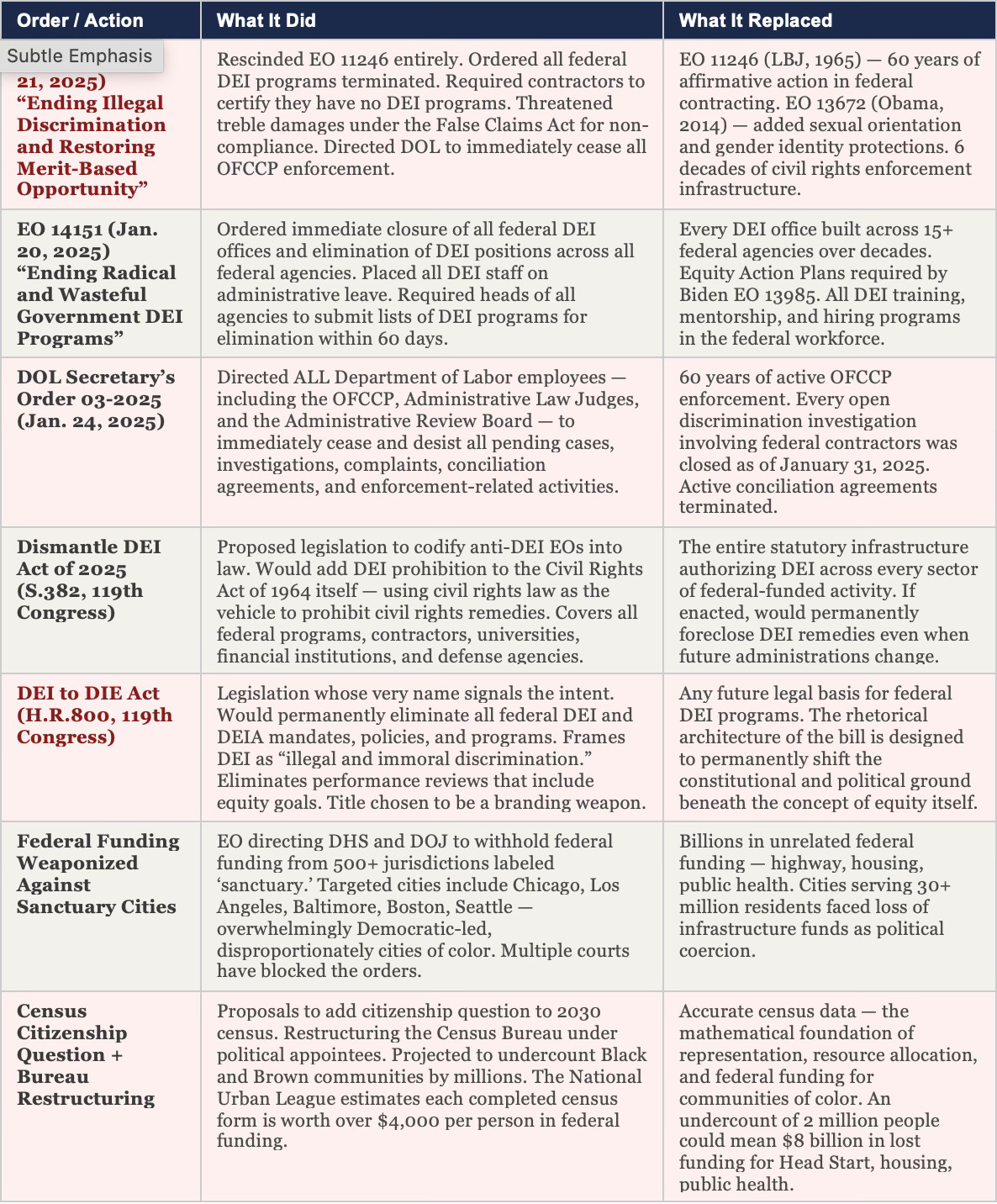
On January 20 and 21, 2025, the new administration signed a cascade of executive orders that dismantled, in the span of 48 hours, the infrastructure of federal inclusion that had been built over six decades. I want to be plain about what was taken. Not in the abstract. In the specific.
Executive Order 11246 was signed by President Lyndon B. Johnson in 1965. It prohibited employment discrimination by federal contractors. It required affirmative action plans. It was the legal backbone of equal opportunity in federal contracting for 60 years. It covered hundreds of thousands of employers and tens of millions of workers. It was enforced by the Office of Federal Contract Compliance Programs, which operated under the Department of Labor.
On January 21, 2025, it was revoked. In its entirety. Effective immediately.
On January 24, 2025, the Acting Secretary of Labor issued Secretary’s Order 03-2025 directing all Department of Labor employees — including every OFCCP investigator, every administrative law judge, every enforcement officer — to immediately cease and desist all pending cases, investigations, complaints, conciliation agreements, and enforcement-related activities. By January 31, 2025, every open discrimination case involving a federal contractor was closed. Not resolved. Closed.
I want that to settle for a moment. Workers who had filed discrimination complaints against federal contractors — workers who had waited months or years for their cases to be heard — received notification that their cases were closed. Not because the discrimination did not occur. Because the administration decided it no longer had the authority to investigate it.
This is not rhetoric. This is the Architecture of Exclusion at work. This is what Bell meant when he said that legal remedies are withdrawn when they are no longer useful to those in power.
The table below documents the full scope of what was eliminated:
V. BELL’S FIVE TENETS — AND TODAY’S ECHO
TENET 1: THE PERMANENCE OF RACISM
Bell’s Thesis: Racism is not a deviation from American ideals. It is embedded in its legal, economic, and social structures. Civil rights victories do not eradicate it — they change its form.
Today’s Reality: Since January 2025, EO 11246 has been rescinded, every federal DEI office has been shuttered, all OFCCP enforcement has been suspended, the VRA has been rendered effectively unenforceable, and legislation formally titled the “DEI to DIE Act” has been introduced. The form has changed. The structure remains.
I remember the morning I read that Executive Order 14173 had been signed. I sat with it. I have been in this work long enough to know that the ground can shift — that every advance contains within it the seeds of the next resistance. Bell knew this too. He wrote that the civil rights victories of the 1950s and 60s were real — and temporary. Not because the people who won them were wrong, but because the system had a way of recalibrating. Of absorbing just enough change to relieve just enough pressure. Until the relief ran out.
What we are witnessing now is the recalibration. The language has changed. Instead of ‘separate but equal,’ we have ‘merit and colorblindness.’ Instead of poll taxes, we have algorithmic voter suppression, Section 2 eviscerated by a 6-3 Supreme Court ruling, citizenship questions engineered to undercount Black and Brown communities by millions, and a census being restructured under political appointees. The architecture of exclusion does not always announce itself with fire hoses. Sometimes it announces itself with executive orders and majority opinions.
TENET 2: INTEREST CONVERGENCE
Bell’s Thesis: The civil rights of Black Americans are only advanced when doing so aligns with the interests of white Americans and power structures. Progress is permitted when it is profitable or politically convenient for the dominant group.
Today’s Reality: Corporations that built DEI offices after George Floyd’s murder in 2020 are now dismantling them. The convergence that made DEI safe evaporated when political pressure made DEI a liability. The moral case did not change. The calculus of interest did. The same week Callaiswas decided, several major corporations quietly removed their DEI commitments from their annual reports.
Bell’s Interest Convergence thesis is perhaps his most uncomfortable assertion — because it requires us to look at the history of racial progress in America not through the lens of moral awakening, but through the lens of self-interest. Brown v. Board of Education, he argued, was decided in 1954 not primarily because the Supreme Court had a moral awakening, but because the United States was locked in a Cold War in which Jim Crow was a global embarrassment. Integration was useful. Integration served an interest beyond the Black community’s interest.
I look at the corporate DEI retreats of 2024 and 2025 and I see Bell’s thesis in motion. The Architecture of Inclusion was only politically safe when inclusion was profitable or when the PR cost of exclusion was high. The moment that calculus reversed — the moment the political cost of inclusion exceeded the reputational cost of retreat — corporations began dismantling the very offices, programs, and positions they had celebrated with press releases just three years earlier.
Cleveland Mayor Justin Bibb, president of the Democratic Mayors Association, has pushed back, making the business case for DEI with the clarity that the moment demands. Birmingham Mayor Randall Woodfin has called the federal anti-DEI offensive the ‘Alabama-ification of the federal government’ — a phrase that deserves to echo. Baltimore Mayor Brandon Scott launched the ‘Definitely Earned It’ campaign to directly challenge the casual degradation embedded in the phrase ‘DEI hire.’ These are not fringe voices. They are the counter-architecture at work.
TENET 3: COUNTER-STORYTELLING
Bell’s Thesis: The dominant narrative erases the lived experiences of marginalized communities. The radical act of telling true stories from the margins is itself a form of resistance and truth-telling.
Today’s Reality: The administration has branded DEI as ‘illegal and immoral discrimination.’ The story being told from the center of power is that the remedy is the disease. The DEI to DIE Act’s very name is a branding weapon. The stories of those who have lived exclusion — the grandmother turned away from the ballot, the worker whose OFCCP case was closed without resolution, the city stripped of federal funds — those stories are being suppressed.
Let me tell you a story. Not a hypothetical. A lived experience.
I grew up in rural eastern North Carolina. And the architecture of exclusion was not theoretical there. It was geographic. It was structural. It was in the roads.
There were roads you did not travel. Not because they were dangerous in the ordinary sense of the word, but because traveling them announced your presence in a space that had not invited you, and invitation — or its absence — was enforced in ways that did not require a sign. You learned which roads those were the way you learned everything important in that place: through the quiet instruction of your elders, through the way a conversation paused when a certain route was mentioned, through the look that said ‘not there, not us, not now.’
There were bathrooms you did not use. Not because they were officially marked — though some were, and the memory of those signs does not leave you — but because even after the signs came down, the understanding remained. The building knew. The people inside the building knew. And you knew that choosing to walk through that door was a choice to assert yourself in a space that had spent generations making clear you did not belong, and the cost of that assertion was not always predictable.
There were stores where you spent your money but never caught a clerk’s eye. There were schools where the bus routes were drawn so that the children of color traveled farthest, arrived latest, and attended buildings that bore the exhaustion of institutions that had never been meant to last. There were churches with no parking lots because when they were built, the assumption was that no one who drove a car would worship there.
I tell you these things not to perform grief. I tell you them because they are the foundation on which everything that comes later must be understood. The architecture of exclusion in eastern North Carolina was not abstract. It was the specific arrangement of roads, bathrooms, school bus routes, bank windows, church parking lots, and polling places — all designed together, all reinforcing each other, all producing a geography of belonging and exclusion that children absorbed before they had words for what they were learning.
This is what Derrick Bell was writing about. Not a metaphor. A map.
Bell called this kind of story-telling ‘counter-narrative’ — the practice of standing up and saying: the dominant version of events is a lie of omission. The people in power rarely need to announce their architecture. They simply build it. And the people for whom the architecture was not built — the ones who learn which roads not to travel, which bathrooms not to use, which banks not to enter — carry that map in their bodies long after the signs come down.
Today, in Galveston County, Texas, the 30 years of Black and Hispanic political power built under the VRA — the first Black mayor, a city commission represented by people of color — is being dismantled through a redistricting map drawn the moment preclearance disappeared. No one wrote ‘we are doing this to suppress Black votes.’ They did not need to. The architecture does not require a confession to function.
TENET 4: CRITIQUE OF COLORBLINDNESS
Bell’s Thesis: The liberal doctrine of ‘colorblindness’ is not neutral. Applied to a system built on racial hierarchy, it preserves the hierarchy while removing the tools needed to dismantle it.
Today’s Reality: The Supreme Court used the colorblindness doctrine to strike down affirmative action in university admissions (2023), to gut the VRA’s redistricting provisions (2026), and to authorize the executive dismantlement of federal DEI infrastructure (2025). The Dismantle DEI Act would use the Civil Rights Act of 1964 as the vehicle to prohibit civil rights remedies. This is not irony. It is strategy.
There is a moment in Bell’s most famous short story — ‘The Space Traders’ — that never leaves me. Extraterrestrials arrive and offer the United States unimaginable wealth and technological salvation in exchange for one thing: every Black person in the country, handed over without explanation, without hearing, without recourse. And America, through a democratic process, votes yes. The story ends with Black Americans, in chains, walking into the alien ships. Voluntarily sacrificed. Legally. Democratically. By a majority.
Bell wrote that story in 1992 as a parable about the limits of legal protection — the way democratic processes can be used to legitimize mass removal when the majority’s interests conflict with the minority’s survival. He was asking a question he already knew the answer to: what would America do, if it could?
I used to read ‘The Space Traders’ as parable. I now read it as prophecy. And the ships are called ICE.
“The immigration prison system was created for Black people. It is also a mirror of the realities of the prison-industrial complex in general in the U.S. that was created to incarcerate newly freed Black people.”
— Guerline Jozef, Co-Founder, Haitian Bridge Alliance
Consider what is happening to Black and Brown immigrants in America in 2025 and 2026. Consider it with Bell’s parable in mind.
Black immigrants make up 5.4 percent of the undocumented population in the United States. They make up 20.3 percent of immigrants facing removal based on criminal convictions — deported at a rate four times their share of the population, despite data showing that all immigrant populations commit crimes at similar rates. Seventy-six percent of Black immigrants are deported due to contact with police, not immigration enforcement — the criminal justice system and the immigration system functioning together as a single architecture of removal. The Space Traders did not need separate ships. They just needed two systems that fed into each other.
Haitian immigrants — children of the first free Black republic in the Western Hemisphere, the revolution that terrified enslavers across the Americas and accelerated the struggle for Black freedom in the United States — had their Temporary Protected Status revoked in February 2025, rendering approximately 350,000 people immediately vulnerable to deportation. The revocation came without adequate process. A federal court later blocked the premature termination, finding that the Department of Homeland Security had failed to provide proper notice. Notice. The basic constitutional requirement of notice was not given. The Space Traders, it turns out, do not believe in due process.
People who showed up to their scheduled immigration court hearings — people who were following the law, fulfilling their legal obligations, trusting the system to treat their appearance as compliance rather than opportunity — were arrested at the courthouse door. Their cases were dismissed not on the merits but so they could be placed in expedited removal proceedings and deported without hearings. The Vera Institute documented this pattern with precision: people being punished for complying with the law. The architecture of the Space Traders does not need a vote. It needs an administrative process designed to produce removal before anyone can object.
ICE issued a memorandum giving certain individuals facing deportation six hours to reach a lawyer. Six hours. Eighty years ago, the Supreme Court ruled that ‘notice which is a mere feint is not due process.’ Six hours’ notice to find legal counsel, understand your rights, and contest the action of the most powerful government on earth is a feint. It is, as one legal commentator wrote, ‘a cruel hoax at worst.’
There is no visible difference between a Haitian immigrant and a Black person born in Houston, Chicago, or Atlanta. None. If ICE is empowered to profile while ‘looking for undocumented immigrants,’ then every Black person becomes vulnerable. And before anyone clings to citizenship papers as a shield — when, in the history of history, has our citizenship ever blocked those with ill intent towards us?
— Kristian A. Smith, writing in The Root, 2026
This is the Space Traders made operational. Bell’s story ends with Black Americans walking in chains into the ships because the law permitted it, the democracy authorized it, and the majority had calculated that the trade was worth making. In 2025 and 2026, U.S. citizens have been detained and deported in what the government calls ‘administrative errors.’ Asylum seekers from Black-majority countries — Cameroon, Haiti, Ghana, Senegal, the Dominican Republic — are deemed ‘not credible’ in fear screenings at rates 37 percent higher than the average for all nationalities. The CBP One app, which migrants must use to schedule asylum appointments, sometimes fails to register Black faces. The architecture of removal has been built into the software.
Bell asked: what would America do if it could remove Black people and call it legal? The answer, in 2025, is that it is trying. It is not doing so with a single dramatic vote. It is doing so through six-hour deportation notices, courthouse arrests, revoked protected status, 287(g) agreements that turn every traffic stop in a Black neighborhood into a potential immigration checkpoint, for-profit detention corporations whose revenue rises with every body detained, and an asylum denial rate for Haitians that, at its peak, reached 82 percent.
The colorblindness doctrine is being used to do precisely what Bell warned in every arena simultaneously: in Callais, Justice Alito wrote that Louisiana’s attempt to comply with the Voting Rights Act was itself an unconstitutional act of racial discrimination. In the executive branch, DEI programs designed to remedy documented structural exclusion have been rebranded as illegal discrimination. And in the immigration system, the systematic over-policing, over-detention, and over-deportation of Black immigrants is rendered invisible by a data-collection system that the Black Alliance for Just Immigration found had been recording inaccurate racial data — hiding the very disparities that would make the pattern legible.
The Space Traders did not need to announce themselves. They just needed the cooperation of a government that had already decided the math made sense.
The False Claims Act provisions embedded in EO 14173 give this strategy enforcement teeth in the workplace as well. Federal contractors must now certify that they have no DEI programs. The legal exposure for non-compliance is not merely a lost contract — it is treble damages. Organizations that spent years building the architecture of inclusion are now being told that their work constitutes illegal discrimination, with financial penalties to match. Two ships. Same direction.
TENET 5: INTEREST DIVERGENCE AND POLITICAL POWER
Bell’s Thesis: Voting rights and political representation are not merely procedural — they are the mechanisms through which Black Americans can exercise power within the system. Those mechanisms are perpetually under threat because Black political power threatens the architecture of white political dominance.
Today’s Reality: Shelby County (2013), Brnovich (2021), Callais (2026): three Supreme Court decisions in 13 years that have systematically dismantled the VRA. In the two weeks since Callais, Tennessee, Florida, and Alabama have moved to eliminate majority-Black districts. The political architecture of exclusion is moving fast.
I think of the elders I know — the ones who were teenagers during Freedom Summer of 1964, who walked through lines of state troopers to register to vote. The ones who remember what it meant when your name was on the list. The ones who understand, in their bones, what it means when the tools of counting and representation are manipulated by those who benefit from your being undercounted.
Bell’s argument was always that voting rights protections were only extended when the political cost of denying them exceeded the political benefit. When that calculus flips — when a political party can run the numbers and determine that its hold on power is strengthened by the disenfranchisement of communities of color — the protections erode. We are watching this erosion in real time. We are watching it in Louisiana. We are watching it in Tennessee. We are watching it in Florida. We are watching it in Alabama.
VI. THE ARCHITECTURE OF EXCLUSION: WHAT BELL SAW AND WHAT I HAVE BUILT
In my work, I distinguish between the Architecture of Inclusion — the deliberate structural design of systems that expand human possibility — and its nemesis, the Architecture of Exclusion: the equally deliberate, equally structural design of systems that constrain it.
The Architecture of Exclusion does not require malicious intent in every person who inhabits it. It requires only that the system be designed in ways that produce exclusionary outcomes, and that the people with the power to redesign it choose not to. It requires the passive participation of those who benefit from the design, even if they did not design it themselves.
Derrick Bell would recognize everything I am describing. He would call it by its proper name. He would note, without particular surprise, that the elimination of DEI offices, the defunding of civil rights enforcement, the use of federal funding as a weapon against cities led by people of color, the dismantlement of the Voting Rights Act across three Supreme Court terms, and the legislative assault on inclusion programs are not isolated political decisions. They are architectural. They are design choices. They are choices about what kind of system we intend to build and who that system is built to serve.
“The Architecture of Exclusion is not a relic of the past. It is a living blueprint. And we are watching its contractors at work.”
— Effenus Henderson
Consider what is happening to the cities. Chicago. Baltimore. Los Angeles. Seattle. These are cities led by mayors of color, serving large communities of color, anchoring the civic and economic life of millions of Americans. In 2025, the administration threatened to withhold federal funding from more than 500 ‘sanctuary jurisdictions’ — a category that, by remarkable coincidence, maps almost perfectly onto cities led by Democrats and people of color. Billions of dollars in unrelated funding — highway funds, housing funds, public health infrastructure — were threatened as leverage.
Courts have repeatedly blocked these attempts. But the attempt itself is the message. You govern at our sufferance. Your cities are legible to us as threats. Your residents’ needs are negotiating chips in our political calculus.
This is the Architecture of Exclusion operating at civic scale. It is federal power used not to strengthen communities but to punish them for electing leaders who refuse to participate in the project of their own marginalization.
VII. WHAT WE ARE LIVING THROUGH — MADE PLAIN
I want to be precise about what I am not saying. I am not saying that everyone who opposes DEI programs is motivated by racial animus. I am saying that the effect of dismantling those programs is racially predictable — and that predictable effect matters as much as stated intent.
Bell made exactly this argument about the law. He said that the courts’ insistence on proving discriminatory intent — rather than examining discriminatory impact — was itself a form of protection for the Architecture of Exclusion. A system can produce racially disparate outcomes by design and remain legally untouchable if no one wrote down their racist intent. The architecture does not need a confession to function.
Except that, in this moment, some of the architects have written it down.
Christopher Rufo, the architect of the anti-CRT and anti-DEI branding operation, published his strategy in plain language in 2021: take the term ‘critical race theory,’ strip it of its actual meaning, fill it with ‘all the various cultural insanities,’ and make it toxic. He then applied the identical playbook to DEI. He later wrote: ‘Fuse the words “California” and “fraud” together in the public mind.’ He has described, in writing, a deliberate disinformation strategy designed to reshape public perception by controlling the brand, not the truth.
This is Bell’s counter-storytelling weaponized against itself. Bell said that counter-narrative — the stories of those who are excluded — is the antidote to the dominant story’s lies. Rufo’s operation is designed to flood the zone: to produce so many counter-narratives of the counter-narrative that truth becomes indistinguishable from noise.
And yet.
“The truth does not stop being true because it has been made unpopular. The architecture of exclusion does not stop being exclusionary because it has been given a new name.”
— Effenus Henderson
The data has not changed. African Americans remain at or near the bottom of nearly every indicator of social and economic well-being — income, education, health, life expectancy, wealth accumulation. These are not statistical artifacts. They are the outputs of systems designed, over centuries, to produce exactly those outcomes. Calling the remedies for those outcomes ‘illegal discrimination’ does not change what they remedied.
And the legal remedies for voting discrimination — purchased at Bloody Sunday, built across 60 years of litigation, reauthorized by Congress in 2006 with overwhelming bipartisan support — have now been rendered ‘all but a dead letter’ by a Court that cannot claim it did not understand what it was doing.
VIII. WHAT BELL WOULD SAY
I find myself, in moments of discouragement, in conversation with Derrick Bell’s ghost.
He would not be surprised. He said, at the end of his life, that he had given up on the hope that the legal system would ever consistently deliver justice for Black Americans. He did not stop fighting. He stopped expecting the fight to end. He called this ‘Racial Realism’ — not cynicism, but the lucid refusal to be continually devastated by an outcome that was always predictable, and the commitment to bearing witness and resistance regardless.
Racial Realism is not despair. It is the opposite of the kind of optimism that evaporates at the first reversal and takes the movement with it. It is a commitment grounded not in the expectation of victory but in the necessity of resistance. Bell kept building. He kept writing. He kept teaching. He understood that the act of articulating truth, of building a framework, of naming the architecture of exclusion with precision, was itself a form of power — even when the courts ruled against you, even when the political ground shifted.
I am writing in that tradition. The Architecture of Inclusion is not a book for a moment when the political wind is favorable. It is a book for this moment — the moment when the architecture is under sustained assault, when the vocabulary has been poisoned, when the remedies are being rebranded as the disease, and when the Supreme Court has just rendered the Voting Rights Act’s last major provision ‘all but a dead letter.’
IX. WHAT WE MUST DO
Bell’s framework gives us clarity. My framework gives us direction. Together, they point toward five imperatives for this moment.
First: name the architecture. Do not accept the framing that DEI is discrimination and its elimination is neutrality. Do not accept the framing that Callais is merely a technical redistricting decision. Name the blueprint. Name the design intent. Name who benefits from the building being constructed.
Second: protect the counter-story. The stories of those who have lived exclusion — the worker whose OFCCP case was closed without resolution, the Galveston County voter whose district was cracked, the Louisiana constituent who elected Black representatives to Congress for the first time in history and then watched that achievement overturned by a 6-3 Court — those stories are the evidence. Collect them. Amplify them. Refuse to let the noise drown them out.
Third: build for permanence. Bell understood that interest convergence means progress is fragile when it is built only on favorable conditions. The Architecture of Inclusion must be embedded in governance, policy, process, and accountability — not just in culture and aspiration. Culture can be changed by a press release. Architecture requires demolition. And where federal architecture has been demolished, state and local architecture must be reinforced.
Fourth: build coalitions that do not depend on interest convergence. Bell’s critique of interest convergence is also an instruction: do not build your movement entirely on the interests of those who will abandon it when the cost rises. Birmingham Mayor Randall Woodfin is right: DEI serves white women, veterans, people with disabilities, working-class Americans who have been excluded by systems that concentrated opportunity in narrow channels. The coalition for inclusion is larger than its opponents want anyone to know.
Fifth: hold the courts accountable to their own stated standards. Justice Kagan has given us the precise language: Section 2 is all but a dead letter. Congress has the authority to respond — as it did in 2006, reauthorizing the VRA with broad bipartisan support. The John Lewis Voting Rights Advancement Act must be revived, strengthened, and passed. State-level Voting Rights Acts must be enacted. The fight for the ballot is not over. It cannot be.
X. THE FACES AT THE BOTTOM OF THE WELL
Bell titled his most famous book Faces at the Bottom of the Well. The image is of Black Americans reflected in the water of a well: faces looking up from the bottom, seeing the circle of sky at the top, unable to reach it but unable to look away.
He meant it as an image of persistence, not defeat. The faces are still there. Still looking up. Still present. Still, in their presence, bearing witness to what the well was built to do.
I grew up in a place where the wells were real. Where the architecture of exclusion was not a theory but a set of roads you memorized, bathrooms you skipped, buildings you walked past without slowing down. I know what it means to carry a map of exclusion in your body before you carry it in your mind. And I know what it means to spend your life building the roads that should have been there all along.
I have been in this work long enough to have stood at the bottom of a few wells. I have also helped build a few ladders. And I know that the people trying to tear the ladders down are, at some level, afraid of what happens when everyone reaches the top.
On April 29, 2026, the Supreme Court handed down Callais. On the same day, Justice Kagan wrote words that will be read as long as democracy in America is contested: ‘For over a decade, this Court has had its sights set on the Voting Rights Act.’ She is right. And the sights are still trained.
But the people who bled for that Act at Selma were not naive about the permanence of the forces arrayed against them either. They were clear-eyed about the difficulty. They kept marching. They kept building. They kept writing the counter-narrative with their bodies and their ballots.
Derrick Bell was not naive about the difficulty. He was clear-eyed about the permanence of the forces arrayed against full inclusion. But he kept writing. He kept teaching. He kept building the counter-narrative, the counter-architecture, the counter-record.
So will I. So must we all.
Effenus Henderson
Architecture of Inclusion Series
May 2026 • Updated Edition
APPENDIX: KEY CASES AND EXECUTIVE ACTIONS CITED
Shelby County v. Holder, 570 U.S. 529 (2013) — Gutted Section 5 preclearance of the Voting Rights Act of 1965.
Brnovich v. Democratic National Committee, 141 S.Ct. 2321 (2021) — Narrowed Section 2 of the VRA, significantly limiting challenges to discriminatory voting practices.
Students for Fair Admissions v. President and Fellows of Harvard College, 600 U.S. 181 (2023) — Struck down race-conscious university admissions programs.
Louisiana v. Callais, 608 U.S. ___ (April 29, 2026) — Struck down Louisiana’s second majority-Black congressional district; rendered Section 2 of the VRA “all but a dead letter” per Kagan, J., dissenting.
Executive Order 14151 (January 20, 2025) — “Ending Radical and Wasteful Government DEI Programs and Preferencing” — Ordered closure of all federal DEI offices and elimination of DEI positions.
Executive Order 14173 (January 21, 2025) — “Ending Illegal Discrimination and Restoring Merit-Based Opportunity” — Rescinded EO 11246 (LBJ, 1965), EO 13672 (Obama, 2014), and all federal affirmative action requirements for contractors.
Secretary’s Order 03-2025, Department of Labor (January 24, 2025) — Ordered all OFCCP enforcement activities immediately ceased. All open cases closed by January 31, 2025.
Dismantle DEI Act of 2025 (S.382, 119th Congress) — Proposed legislation to codify anti-DEI executive orders and add DEI prohibition to the Civil Rights Act of 1964.
DEI to DIE Act (H.R. 800, 119th Congress) — Proposed legislation permanently eliminating all federal DEI and DEIA mandates.