
DEMOGRAPHIC CALIBRATION
The Defining Challenge of a Pluralistic Age

Prologue: The Wrong Question
America is asking the wrong question.
For decades, the dominant frame in conversations about diversity, equity,
and inclusion has been corrective — focused on remedying historic
exclusion through mandates, programs, and policy interventions. That
frame was necessary, and it produced genuine progress. But as the country
crosses into a new demographic era — one in which no single group will
hold permanent numerical dominance — the corrective frame is no longer
sufficient.
The real question before us is not whether diversity should be
acknowledged.
The real question is whether our institutions — organizational, democratic,
technological — are capable of continuously calibrating themselves to a
society that is already, irreversibly, pluralistic.
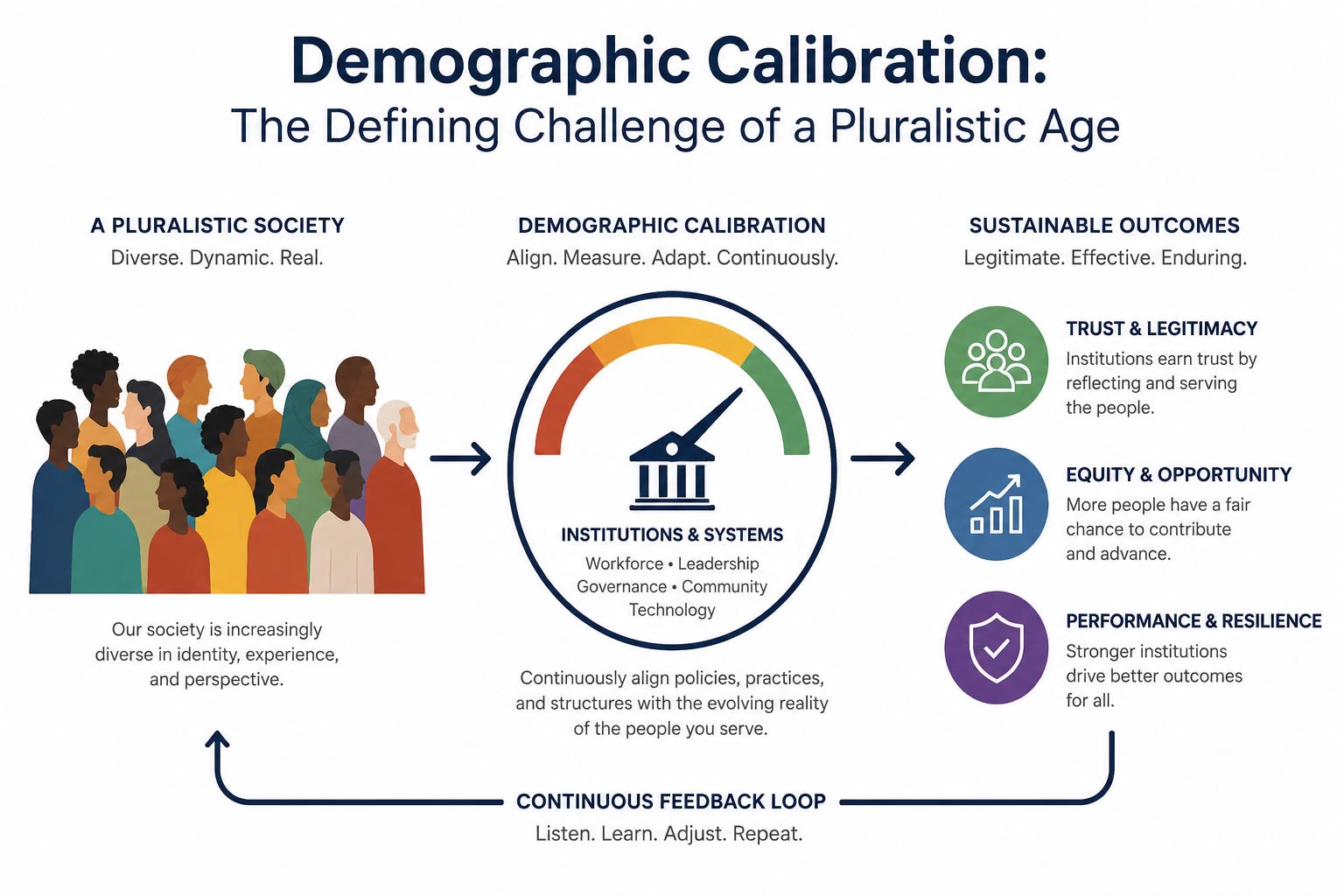
This is the essence of Demographic Calibration: the ongoing, evidence-
driven process of aligning workforce systems, governance structures,
community relationships, leadership pipelines, and increasingly, the digital
technologies that augment human thought itself — with the rapidly evolving
demographic realities of the world those institutions are meant to serve.
It is a theory of systems sustainability. It is a theory of institutional
legitimacy. And as the evidence increasingly shows, it is also the terrain on
which some of the most consequential battles of the modern democratic era
are now being fought.
Part I: The Google Settlement and What It Really Reveals
When a California federal judge granted final approval for a $50 million
settlement in a race discrimination class action against Google, the story
barely made the front pages. The OpenAI verdict dominated coverage that
week, and the Google resolution was largely absorbed into the noise of a
news cycle already saturated with AI, tech regulation, and political theater.
That was a mistake.
Because the Google settlement may be one of the most instructive case
studies in organizational systems failure that American employment law has
produced in a generation.
Consider what was alleged. Not a single manager’s bad day. Not an isolated
hiring decision or an overheard remark. The claims involved 3,715 Black
employees in California and New York who asserted that Google’s systems
— its compensation frameworks, job leveling processes, promotion
pathways, and opportunity structures — had functioned in ways that
persistently steered them into lower-paying roles, blocked advancement,
and produced recurring patterns of inequitable outcomes.
What makes this extraordinary is the context in which it occurred.
Google is not an organization that lacked resources for compliance. With
approximately 900 in-house attorneys, sophisticated pay equity analysis
systems, DEI initiatives, workforce analytics infrastructure, and former
Department of Justice attorneys on staff, Google had built one of the most
advanced compliance architectures in the world. And yet the settlement —
one of the largest discrimination resolutions in the history of the technology
sector — still arrived.
The lesson is not that Google was uniquely malicious.
The lesson is that sophistication does not guarantee calibration.
Organizations can possess extraordinary analytical capability while still
producing distorted outcomes if their systems are not continuously
evaluated against measurable patterns, lived workforce realities, and the
structural frameworks that civil rights law has spent decades carefully
constructing.
As part of the settlement terms, Google must now conduct race-based pay
equity analysis before finalizing salaries each year, for at least three years.
Unexplained disparities will trigger investigation and corrective action. The
company also agreed to pause mandatory arbitration on employment claims
through August 2026 — meaning future discrimination claims can proceed
before a jury, not disappear into binding arbitration.
These are not symbolic gestures. They are calibration requirements,
imposed externally because internal systems failed to produce them
voluntarily.
The question every organizational leader should be asking is not: Was
Google uniquely negligent?
The question is: If Google’s infrastructure couldn’t prevent this, what
does that mean for yours?
Part II: The Legal Architecture — Griggs, Title VII, and Why Pattern Matters
To understand why the Google case matters so deeply, it is essential to
understand the legal and intellectual architecture that makes systemic
claims possible in the first place.
Title VII of the Civil Rights Act of 1964 established the foundational
prohibition against employment discrimination based on race, color,
religion, sex, and national origin. But the Act’s meaning was substantially
deepened eight years later by the Supreme Court’s landmark ruling in
Griggs v. Duke Power Co. (1971).
Griggs was transformative because it recognized a truth about modern
discrimination that the explicit-intent framework alone could not capture:
systems themselves can produce discriminatory outcomes, even
absent overt discriminatory purpose.
Duke Power’s requirement that employees hold a high school diploma and
pass a standardized test to transfer into better-paying positions appeared
facially neutral. But the Court found that where such requirements
disproportionately disadvantaged Black workers — and bore no
demonstrable relationship to job performance — they violated Title VII
regardless of intent.
That ruling gave American civil rights law the doctrine of disparate
impact.
Disparate impact shifts the analytical frame from intent to outcomes. It asks
not whether someone meant to discriminate, but whether a policy, practice,
or system produced measurably unequal consequences for a protected
class. It is the legal expression of what demographic calibration demands
operationally: the willingness to examine not what an organization says, but
what its systems actually produce.
Pattern. Practice. System. Outcome.
That is the essence of disparate impact analysis. And that is why the Google
settlement matters not just as a legal resolution, but as an organizational
revelation.
Part III: Pipeline Dilution — The Silent Architecture of Exclusion
Within the framework of demographic calibration, one of the most
structurally dangerous phenomena is what I call pipeline dilution.
Pipeline dilution occurs when qualified talent from a protected class is
progressively filtered, marginalized, or prevented from advancing at
equitable rates within organizational systems — not through overt
exclusion, but through the accumulative weight of systemic friction at every
stage of the talent journey.
It appears in:
• Referral-based hiring that reproduces existing social networks
• Educational credentialing that filters through historical access
inequities
• Manager discretion systems with insufficient accountability structures
• Performance calibration meetings that introduce subjective bias at
scale
• Sponsorship and stretch-assignment access controlled through
informal networks
• Leadership visibility determined by proximity to power
Individually, each of these mechanisms may appear defensible. Collectively,
they can function as a sophisticated exclusionary architecture — producing
statistically observable disparities while maintaining a surface appearance
of procedural fairness.
This is precisely why disparate impact analysis is so important. It allows
organizations to see the cumulative effect of systems that may each appear
neutral in isolation but function together as a machinery of dilution.
You cannot correct what you cannot see. And if you eliminate the
instruments of sight, the distortion simply continues beneath the
surface, invisible and unchallenged.
Part IV: The Selective Enforcement Question
Not every settlement, however, represents a finding of systemic inequity.
And demographic calibration demands intellectual honesty about this
distinction as much as it demands rigor about structural discrimination.
Consider the contrast between the Google settlement and two other recent
high-profile actions.
The Department of Justice’s $17 million settlement with IBM under
the False Claims Act alleged that IBM failed to comply with federal
contractor anti-discrimination requirements through what the government
characterized as improper DEI practices. IBM — which has maintained one
of the most consistently progressive diversity and inclusion programs in
corporate America over many decades — settled.
But settlements are not synonymous with adjudicated findings.
Organizations settle for many reasons: litigation risk, government
contractor exposure, shareholder anxiety, reputational concerns, and the
simple calculus of regulatory pragmatism. The critical calibration question
in the IBM case is whether there existed a demonstrable, classwide pattern
of systemic harm — statistically significant pipeline dilution, measurable
disparate impact against a protected class — or whether the settlement
represented something else: a political signal, an enforcement action
designed to create fear among employers with progressive DEI
commitments.
A similar question arises from the EEOC’s action involving The New
York Times, which appears to center on a white male employee’s individual
promotion claim. Title VII protects all protected classes, and no serious
framework of demographic calibration denies that. But calibration also
demands contextual proportionality. It requires asking: Is there a fact
pattern suggesting widespread, systemic discrimination against white men
within this organization? Where is the evidence of organizational
patterning, of statistical disparity, of measurable pipeline dilution affecting
this group?
Demographic calibration does not exempt any group from
protection. But it insists that enforcement be grounded in evidence,
proportionality, and systemic pattern analysis — not in political
ambition or ideological grievance.
The danger is not enforcement itself. The danger is selective enforcement
without calibration — a condition in which the tools of civil rights law are
deployed not to reveal and remedy systemic disadvantage, but to reframe
enforcement around the preservation of historical concentrations of
advantage, while simultaneously dismantling the measurement systems that
would expose such concentrations as the evidence problem they represent.
Part V: The Attack on Measurement Is an Attack on Reality
There is a through-line connecting the erosion of disparate impact analysis,
the politicization of EEO-1 reporting, the weakening of OFCCP oversight,
and the broader assault on DEI infrastructure.
That through-line is the relationship between visibility and
accountability.
The Washington Post has reported that the EEOC has proposed halting
longstanding demographic data collection from major employers. Critics —
including career civil rights enforcement professionals — have argued that
such a move would fundamentally undermine the agency’s ability to identify
systemic discrimination precisely because systemic discrimination requires
systemic data to detect.
This is not a bureaucratic dispute about reporting forms.
It is a dispute about whether society will retain the ability to see structural
inequity at all.
EEO-1 reports, workforce analyses, adverse impact studies, pay equity
reviews — these were never designed merely as compliance exercises. They
were designed as organizational MRIs. Diagnostic instruments.
Calibration tools. They allow organizations, regulators, and courts to
identify the difference between isolated incidents and structural patterns,
between individual grievance and systemic harm.
When those instruments are weakened, dismantled, or politically
marginalized, something specific happens: the baseline of visibility required
to identify systemic discrimination begins to erode. And as visibility erodes,
the organizations most likely to benefit are those whose internal systems
already produce patterned advantages for historically overrepresented
groups.
Calibration without measurement is guesswork. Neutrality without
analysis reinforces exclusion. And the deliberate removal of
measurement tools in the name of fairness is, paradoxically, one of
the most precise methods of preserving structural unfairness that
institutional actors have yet devised.
Part VI: Democracy as a Calibration Problem
The same structural logic that applies to workforce systems applies to
democratic participation systems. And one of the clearest illustrations of
demographic calibration under attack in the political domain is the
continuing erosion of Voting Rights Act protections — accelerated by the
Supreme Court’s ruling in Shelby County v. Holder, which invalidated the
preclearance provisions that had historically required certain jurisdictions
with documented histories of discrimination to obtain federal approval
before changing voting procedures.
What followed, in state after state, was a wave of redistricting processes
that warrant the same analytical lens that disparate impact analysis applies
to employment systems.
Redistricting maps may appear facially neutral. Procedurally compliant.
Administratively justified. But if the measurable outcome is the recurring
fragmentation, dispersal, or dilution of collective electoral influence among
minority populations — in jurisdictions where those populations have grown
substantially as a share of the electorate — then the calibration question
demands honest confrontation: Are these systems functioning as
instruments of broader democratic participation, or as instruments for the
preservation of concentrated political power?
In states and regions across the South where minority populations
represent more than a quarter of total residents, the pattern of district
design increasingly suggests a systematic effort to dilute representational
influence — not through the blunt instruments of poll taxes or literacy tests,
but through the sophisticated geometry of cracking and packing, of
dispersing cohesive minority communities across multiple majority-white
districts or concentrating them into single, heavily packed ones.
Democratic legitimacy, like organizational legitimacy, depends on
calibration. A democracy in which demographic growth does not translate
into proportional representational influence is a democracy whose
calibration systems are failing — or being deliberately disabled.
Part VII: Technological Dilution and the New Frontier of Calibration
But there is a third domain in which the logic of demographic calibration
now demands urgent attention — one that is less understood but potentially
more consequential for the long-term integrity of democratic discourse.
Technological dilution occurs when the systems being used to augment
human reasoning — AI assistants, retrieval systems, conversational
interfaces, augmentation architectures — unintentionally interrupt,
fragment, soften, redirect, or prematurely constrain the development of
emerging thought before the full architecture of the argument has been
articulated.
This matters enormously because complex systemic arguments do not arrive
pre-formed. They develop iteratively. They require exploration,
contradiction, synthesis, and refinement. Theories around disparate impact,
demographic calibration, institutional overconcentration, and pluralistic
sustainability are layered concepts that require intellectual space to fully
emerge.
When technological systems interrupt that continuity — even through well-
intentioned safety mechanisms — the architecture of the thought itself can
be diluted. Intellectual momentum fractures. The rhetorical and analytical
coherence of the argument weakens. And the practitioner building the case
is forced to reconstruct, from fragments, what might have been a seamless
and powerful whole.
Historically marginalized communities and civil rights advocates have long
experienced interruption, reinterpretation, dismissal, and the fragmentation
of narrative authority — in institutions, in courts, in media, in workplaces. If
AI systems unintentionally reproduce those same dynamics through
technological interaction patterns, then the technology begins to participate
in the very power asymmetries that demographic calibration seeks to
address.
The governance question for technology companies is therefore not simply:
Can AI avoid explicit bias in its outputs?
The deeper question is: Can AI preserve cognitive equity — the right of
diverse frameworks of analysis to fully emerge, develop, and achieve
structural coherence before intervention occurs?
Part VIII: From Affirmative Action to Pluralistic Sustainability
To understand the full significance of demographic calibration as a
framework, it is necessary to locate it historically — to understand what it is
building upon and how it differs from what came before.
Affirmative action emerged as a remedial framework. It sought to interrupt
patterns of explicit exclusion that had historically advantaged one dominant
demographic group through law, policy, education, housing, and
employment systems. It was corrective in design and necessary in its time.
But demographic calibration is something broader. It is not remediation. It
is systems sustainability.
The United States is becoming majority-minority. No single demographic
group will permanently maintain overwhelming numerical dominance in the
decades ahead. This creates a profound transformation in how institutions
must think about governance, opportunity, and organizational design.
When systems become excessively calibrated toward preserving the
dominance of one demographic identity in a society that has fundamentally
changed around them, several consequences emerge with predictable
consistency: declining trust, rising polarization, weakened legitimacy, social
fragmentation, labor shortages, talent dilution, economic instability, and
democratic erosion.
These are not ideological predictions. They are systems outcomes.
Demographic calibration is therefore not about replacing one dominant
group with another. It is not reverse domination. It is not demographic
revenge. It is the recognition that pluralistic societies require balancing
mechanisms that allow broader participation in opportunity,
influence, leadership, innovation, and institutional design — not
because any group is inherently entitled to proportional representation in
every outcome, but because systems that concentrate advantage within
narrowing demographic structures while the surrounding society grows
more plural become increasingly unstable over time.
The objective is sustainability. The objective is legitimacy. The objective is
adaptive capacity.
America is not simply moving forward from historical exclusion. It is moving
toward a fundamentally new condition — one in which democratic
legitimacy will depend increasingly on whether institutions can maintain
broad representational participation across a pluralistic population that has
no single demographic center.
That is a harder problem than the country faced in 1964. It is also a more
consequential one.
Conclusion: The Defect Is Distortion
There is a recurring phrase that runs through this entire analysis, and it is
worth stating plainly at the close.
Diversity is not the defect. Distorted calibration is.
The danger is not that America is becoming multiracial, multicultural,
multigenerational, and identity-complex. Those conditions represent the
natural expression of a pluralistic democracy’s evolution.
The danger is that institutions — organizational, democratic, and now
technological — are losing the systems, the instruments, and the will to see
themselves clearly.
When EEO-1 reporting is questioned, disparate impact analysis is attacked,
pay equity reviews are politicized, voting protections are eroded,
redistricting systems are weaponized, DEI infrastructure is dismantled, and
AI systems interrupt the cognitive continuity of those trying to name and
analyze these patterns — what is being destroyed is not bureaucracy.
What is being destroyed is visibility.
And without visibility, inequality normalizes. Exclusion masquerades as
neutrality. Concentrated power preserves itself beneath the language of
reform. And the tools designed to reveal distortion are systematically
removed — not through dramatic acts of oppression, but through the
patient, procedurally neutral architecture of institutional de-calibration.
The $50 million Google settlement tells us that even the most sophisticated
organizational systems can produce structural distortion when left
uncalibrated against real outcomes. The attacks on EEO-1 reporting and
disparate impact analysis tell us that some actors prefer the distortion to
remain invisible. The erosion of voting rights protections tells us that this
dynamic extends from the boardroom to the ballot. And the emerging
problem of technological dilution tells us that the calibration challenge now
reaches into the very cognitive infrastructure through which we attempt to
analyze these problems in the first place.
Demographic calibration is therefore not a diversity initiative. It is a
governance discipline. It is a systems sustainability framework. It is a legal
and organizational necessity. And it is, increasingly, one of the central
questions of democratic legitimacy in an age defined by pluralism, artificial
intelligence, and the ongoing struggle to determine who gets to see the
patterns — and who retains the power to name them.
The future belongs to organizations, institutions, and societies capable of
continuous recalibration — of honestly measuring what their systems
produce, adjusting when patterns reveal distortion, and preserving the
analytical visibility required to tell the difference between neutrality and the
preservation of advantage.
That capability, in the decades ahead, will not simply be a competitive
differentiator.
It will be the architecture of democratic survival itself.
About the Author
Effenus Henderson is a thought leader, strategist, and architect of the Demographic
Calibration and SPINE frameworks, focused on organizational sustainability, inclusive leadership, and the intersection of civil rights law, workforce systems design, and democratic governance.