
Presumption
There is a quiet but powerful shift underway — one that turns a foundational legal principle on its head. Not amended. Not clarified. Inverted.

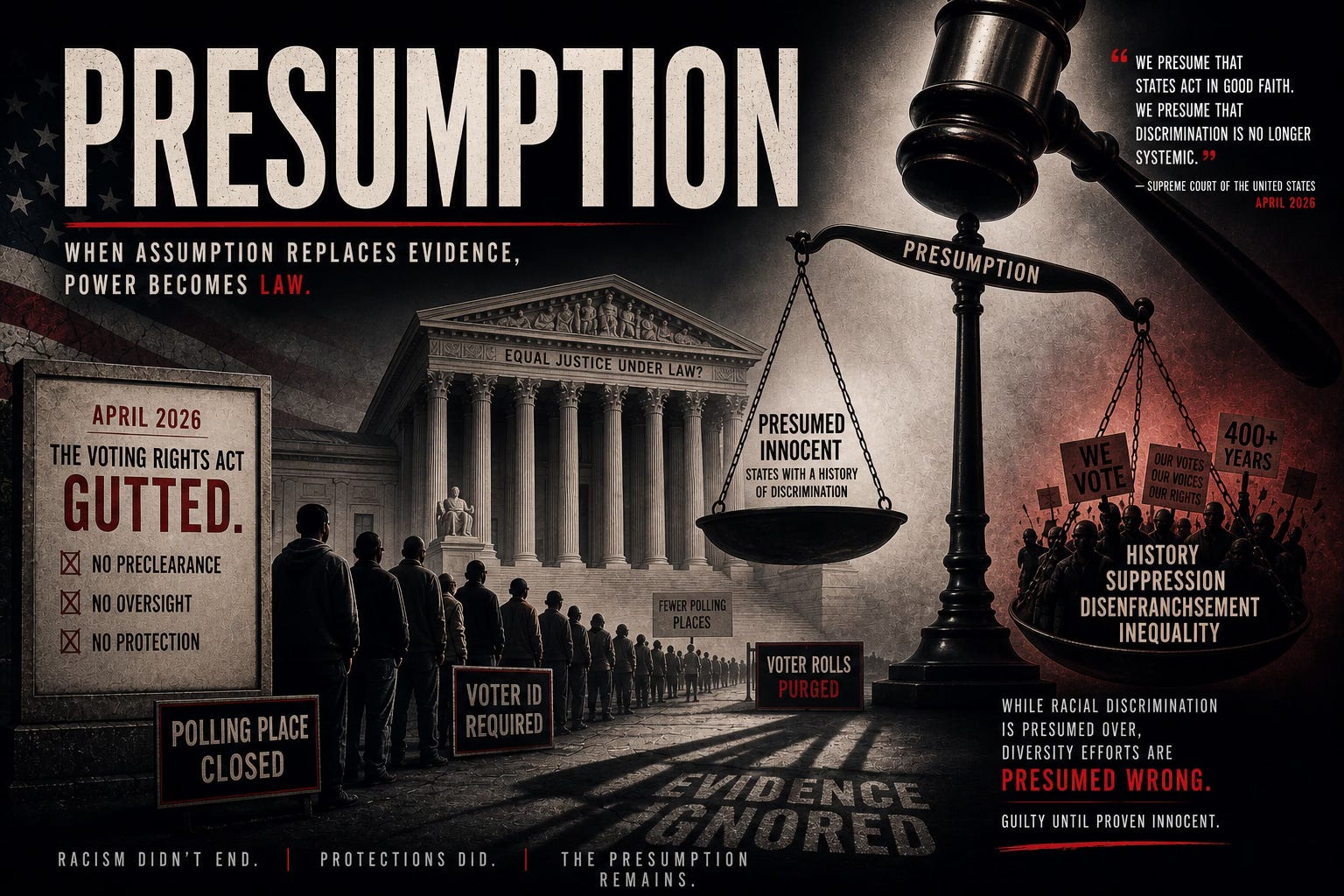
There is a quiet but powerful shift underway — one that turns a foundational legal principle on its head. Not amended. Not clarified. Inverted.
To understand it, start with a single word.
Presume.
I. The Decision
In April 2026, the Supreme Court gutted the Voting Rights Act. The remaining coverage formula — what little survived the 2013 Shelby County v. Holder decision — was struck down. Federal oversight of jurisdictions with documented histories of racist voting laws no longer met, the Court ruled, “current constitutional standards.” The dissenting justices named it plainly: judicial abandonment.
The reasoning, recycled and polished, turned on a presumption:
“Our country has changed. The extraordinary measures of the Voting Rights Act are no longer justified by current conditions. We presume that states act in good faith.”
The Court did not ask for evidence that racism had ended. It did not require proof that voter suppression had ceased. It did not study the flood of post-Shelby suppression laws, or the data showing that preclearance demonstrably worked, or the racially polarized voting patterns documented in state after state. It simply declared a presumption of innocence — for repeat offenders — and dared anyone to prove otherwise, with the burden impossibly high and the tools removed.
Within weeks of the April 2026 decision, three states announced new voter ID requirements, polling place closures in majority-Black counties, and mass purges of voter rolls. Legal challenges were filed immediately. But without preclearance, those challenges will take years — years during which elections are held, and the presumption of innocence functions exactly as designed: as a shield.
II. Three Presumptions
I want to be precise about what kind of presumption this is — because there are three of them operating simultaneously, and only by naming them clearly can we see what has actually happened.
The first presumption is innocence. States with documented histories of racial voter suppression are presumed to be acting fairly, absent specific, case-by-case proof that they are not. The burden of demonstration falls on the people harmed, after the harm occurs.
The second presumption is guilt. I have watched organizations with structured hiring processes, transparent metrics, and documented outreach strategies become targets of suspicion based on a single demographic data point, a single anecdote, a single imbalance that no one has investigated. From that moment, a narrative locks: something must be wrong, someone must be biased, this must be illegal. No inquiry precedes the conclusion. Judgment precedes analysis.
The third presumption — the quietest and most consequential — is irrelevance. History doesn’t count. Four hundred years of unequal conditions, of deliberately segregated labor markets, of wealth gaps that did not emerge by accident — none of it is admitted as context for the single data point under scrutiny. The system is presumed to have been neutral all along. Only the remedy is suspect.
These three presumptions, operating together, constitute a complete architecture. Innocence for systems. Guilt for remedies. Irrelevance for everything that happened between the two.
III. The Trojan Horse
There is a habit of reading Supreme Court decisions for what they decide. The more important question is what they permit — what doctrinal logic they introduce, leave uncontested, and position for future use.
Read the April 2026 VRA decision that way, and what you find inside it is not merely the end of federal voting oversight. You find the assembled components of a direct challenge to Title VII of the Civil Rights Act of 1964 — specifically, to the doctrine of disparate impact.
Disparate impact — established in Griggs v. Duke Power Co. in 1971 — holds that a practice does not need to be intentionally discriminatory to be unlawful. If it produces racially unequal outcomes and cannot be justified by business necessity, it violates the Act. Intent is not the test. Effect is. For more than fifty years, this doctrine has been the primary legal mechanism by which structural discrimination — discrimination baked into facially neutral policies — could be challenged and remedied.
This doctrine has never been popular with the Court’s conservative wing. The Rehnquist Court weakened it significantly in Wards Cove Packing Co. v. Atonio (1989), shifting the burden of proof to plaintiffs and narrowing the standard for business justification. Congress responded by restoring the Griggs standard in the Civil Rights Act of 1991 — a direct legislative rebuke. Then, in 2009, Justice Scalia used Ricci v. DeStefano to plant a seed with unusual precision, calling disparate impact doctrine a “statutory time bomb” — a standard so focused on racial outcomes that it risked, in his framing, becoming unconstitutional disparate treatment of majority groups. He was writing for the future. The Court was not yet ready.
It may be ready now.
The April 2026 decision has provided three doctrinal gifts to anyone preparing that challenge.
The first gift is the presumption of good faith. If courts are to presume that states act in good faith absent specific evidence of intentional discrimination, the logical extension to employment is direct: employers, too, are presumed to act in good faith, recentering the entire analytical inquiry on intent rather than outcome. Disparate impact doctrine survives only if outcome, absent proven intent, can still constitute actionable discrimination. The new presumption architecture makes that position increasingly difficult to sustain.
The second gift is the inadmissibility of history. The April 2026 decision held that historical evidence of systemic discrimination — documented patterns of suppression, decades of racially polarized outcomes, the demonstrated effectiveness of the preclearance remedy itself — was insufficient to justify the VRA’s continued operation. If that category of evidence cannot sustain a federal voting rights law, it is difficult to argue that the same category of evidence — statistical disparity, historical exclusion, documented patterns of racially skewed outcomes — survives as the evidentiary foundation of a disparate impact claim in employment. The Court did not say this explicitly. It did not need to. Doctrinal logic does not require announcement.
The third gift is the framing established by Students for Fair Admissions v. Harvard (2023). That decision held that race-conscious admissions violated equal protection, with majority reasoning that any institutional accounting for race is presumptively discriminatory, regardless of its remedial purpose. In April 2026, that framing — any race-consciousness is itself racial discrimination — migrated from higher education into the constitutional doctrine governing federal civil rights oversight. The trajectory is visible. The next step is applying it to the employment context directly.
These three moves, taken together, constitute a framework. It arrived dressed as a federalism argument about voting rights. But the payload — the legal capacity to argue that disparate impact analysis is itself unconstitutional disparate treatment of non-minority groups — has now been delivered inside the walls.
The Civil Rights Act of 1991 restored Griggs after Wards Cove weakened it. Congress acted. But the current Court has shown no hesitation in reviewing statutory interpretation it finds in tension with its evolving equal protection doctrine. And the composition of both the Court and Congress in 2026 offers cold comfort to anyone counting on a legislative repair.
What is being constructed, decision by decision, is a legal architecture in which the only cognizable discrimination is intentional, provable, and entirely case-by-case — uncontaminated by systemic framing, institutional history, or statistical pattern. In that architecture, disparate impact is not simply weakened. It is definitionally eliminated — because by the Court’s new presumptions, systems are fair, history is inadmissible, and any remedy that accounts for race is, itself, the discrimination.
The VRA case was the delivery mechanism. Title VII is the target.
IV. The Collapse of Evidentiary Rigor
The legal framework surrounding these questions is familiar. Title VII requires proof of discrimination — claims are tested, evidence is weighed, harm is demonstrated. In a functioning system, that rigor protects everyone.
What we are witnessing is a selective collapse of that rigor.
The same legal logic that demands strict scrutiny of race-conscious remedies — requiring employers and universities to justify every diversity measure with near-impossible precision — refuses to apply equivalent scrutiny to the centuries of accumulated advantage already embedded in every institution. Conservative litigants in the post-SFFA landscape, in ongoing circuit court challenges, and in a wave of executive orders targeting federal contractors have moved in this direction in lockstep: assertions without evidentiary review, claims of harm without defined injury, conclusions drawn before investigation has begun.
Diversity efforts are treated as guilty until proven innocent. Voter suppression laws, meanwhile, are treated as innocent until proven discriminatory — a burden that, post-April 2026, has been made functionally impossible to meet.
The sequence is reversed. Judgment precedes analysis. And once that reversal is ratified by the highest court in the land, it does not simply influence future decisions. It becomes the water in which every subsequent legal argument swims.
V. The Missing Variable
What is consistently absent in all three presumptions is context.
To isolate one hiring outcome and attribute it solely to a DEI program — without examining the system of privilege, pipeline, and precedent in which that outcome sits — is not analysis. It is assumption with a law degree. And it arrives at the exact moment a Supreme Court majority has declared that the context of American racial history is no longer legally relevant to American civil rights law.
This is the core provocation.
If the Court can presume that a system built on racial subordination has become colorblind — presumes it so strongly that it dismantles the only federal mechanism that ever proved otherwise, and now positions that same logic to eliminate the doctrine that measures discriminatory effect rather than discriminatory intent — on what basis should we trust any presumption of fairness in the systems those laws were designed to address?
The answer is that we should not simply trust it. We should require it to be demonstrated. That is what evidence is for. That is what process is for.
But process requires that both sides bear their burdens consistently. The state that passes a new voter ID law should demonstrate that it does not suppress minority turnout. The employer claiming reverse discrimination should demonstrate actual harm, not merely statistical disproportion. The Court that strikes down a civil rights law should demonstrate that the conditions it addressed no longer exist.
In April 2026, the Court declined that burden. It presumed instead. And in doing so, it handed future litigants the tools to dismantle not just the Voting Rights Act, but the disparate impact doctrine that has been the quiet backbone of workplace civil rights enforcement for more than half a century.
VI. What Is Required
Here is the paradox at the center of this moment.
In the name of protecting fairness, we are dismantling the only tools that ever made fairness measurable. Fairness is not the absence of scrutiny. It is the presence of disciplined, historically informed, evidence-based scrutiny — applied consistently, to everyone, in both directions.
The Voting Rights Act was that kind of fairness. It worked. It was gutted anyway.
Disparate impact doctrine is that kind of fairness. It measured effect rather than intent, because effect is what people actually experience. It may be next.
When presumption replaces proof — when systems are declared innocent before they are examined, remedies are declared guilty before they are analyzed, and history is declared irrelevant before it is weighed — we do not return to neutrality. There is no neutral to return to. We return to the status quo ante, where documented harm receives the benefit of no doubt, and documented remedy receives the benefit of none.
So let me be precise about what I am and am not asking.
I am not asking you to presume guilt.
I am asking you to apply the same evidentiary standard in both directions. Require proof of harm before finding it. Require proof of failure before dismantling a remedy. Require context before rendering judgment — not as a courtesy, but as the minimum that rigorous legal and institutional analysis has always demanded.
The Court abandoned that minimum in April 2026. What it left inside the decision — hidden in plain sight, dressed in the language of federalism and good faith — was the architecture for a much larger dismantling.
The Trojan Horse is already inside. The question now is whether the institutions that remain will recognize it for what it is, or open the gates themselves, one presumption at a time.
The writer works in organizational equity and workforce strategy.
The IBM Settlement Through the Lens of the Three Presumptions
The IBM $17M FCA settlement is not merely a compliance story. Viewed through the framework of the Three Presumptions, it is a precise legal demonstration of the architecture the document describes — and arguably its most consequential real-world application to date in the employment context.
Presumption One: Innocence (For the System)
The False Claims Act was designed to punish fraud against the government — contractors who overbilled, misrepresented capabilities, or delivered defective goods. It was a tool built to hold systems accountable.
In the IBM settlement, that instrument has been inverted. The system — federal contracting, with its documented history of racial exclusion, supplier disparities, and workforce stratification — is presumed to have been operating fairly all along. IBM's DEI programs are framed not as a response to documented inequity, but as the introduction of discrimination into an otherwise neutral marketplace.
The government did not ask: What conditions did these programs respond to? It did not examine whether the federal contracting ecosystem IBM operates within reflected equal access or opportunity. It presumed the baseline was fair, then prosecuted the deviation from it.
This is Presumption One operating at institutional scale.
Presumption Two: Guilt (For the Remedy)
IBM did not wait for a court to find it liable. The settlement terms, the cooperation credit, the early factual disclosures — these reflect what the document calls "a business decision not to litigate," made under conditions where the presumption of guilt was already structurally embedded.
Consider the specific practices cited: tying executive compensation to diversity goals, diverse interview slates, structured outreach sourcing. These are not novel or reckless improvisations. They are standard, documented, peer-reviewed tools of equitable workforce practice — practices recommended by SHRM, validated in organizational research, and implemented in response to decades of evidence showing that without structured intervention, hiring defaults systematically disadvantage protected classes.
Under the Civil Rights Fraud Initiative, those practices became evidence of fraud. Not because harm was demonstrated. Not because investigation preceded conclusion. Because the administration's presumption — that any race-conscious process is itself discrimination — was sufficient to initiate enforcement, impose burden, and extract $17 million before a single court finding was made.
Judgment preceded analysis. That is Presumption Two.
Presumption Three: Irrelevance (For History)
This is where the IBM settlement most directly channels the April 2026 VRA decision's doctrinal logic.
The DOJ's Civil Rights Fraud Initiative framing treats IBM's DEI programs as originating in a vacuum — as if there is no documented history of racial and gender exclusion in the technology industry, no pipeline research, no audit data showing that without intervention, protected classes are systematically underrepresented in hiring, promotion, and compensation. None of that context appears in the settlement framing. None of it was admitted as a mitigating factor in the government's theory of liability.
IBM's programs existed because evidence said they were necessary. That evidence has been declared irrelevant to the question of whether the programs were lawful.
This is precisely the evidentiary move the document identifies in the VRA ruling: historical patterns of documented discrimination are inadmissible as justification for ongoing remedies. The Court said it about voting. The DOJ's enforcement posture is now saying it about employment. The mechanism differs; the logic is identical.
The FCA as the Delivery Vehicle
What the document describes as the Trojan Horse — doctrinal architecture dressed in the language of federalism and good faith — has a specific vehicular form in the employment context: the False Claims Act.
The FCA is a powerful instrument. Treble damages. Civil penalties. Whistleblower incentives. It was designed for fraud — for knowingly false claims, for intentional misrepresentation. Its application to DEI programs requires a specific doctrinal sleight of hand: redefining compliance with anti-discrimination law as itself a form of fraudulent misrepresentation.
That move is only possible if you first establish that:
Systems are presumed innocent (so the baseline needs no scrutiny),
Remedies are presumed guilty (so structured intervention is presumptively discriminatory), and
History is irrelevant (so the conditions that justified the remedy cannot be introduced in its defense).
The IBM settlement did not require a court to make those findings. The enforcement structure made them operationally true before litigation ever began.
What This Means for HR Professionals
The document ends with a demand for evidentiary consistency — apply the same standard in both directions. That demand is now acutely practical.
HR professionals and employment counsel advising federal contractors are operating inside a framework where:
The burden of proof has been selectively reversed. DEI programs must justify themselves with near-impossible precision, while the systemic conditions they respond to require no justification at all.
Cooperation is not protection. IBM received credit for cooperation — and still paid $17M. The lesson is not that good-faith engagement with government investigators produces safety. It produces a reduced penalty within a predetermined outcome.
The FCA's scienter standard is being stretched. IBM "knowingly" maintained programs it had implemented transparently, publicly, and in alignment with prior guidance. The government's application of "knowing" fraud to good-faith compliance practices is a doctrinal expansion that, left unchallenged, makes every structured equity program a potential FCA exposure.
Disparate impact doctrine is the next target. If the legal architecture described in the document is correct — and the IBM settlement is evidence that it is materializing — then the doctrine that allows employment discrimination claims based on effect rather than intent is now directly in the crosshairs. Once that doctrine falls, the evidentiary tools for proving structural discrimination in the workplace largely disappear.
The Precise Inversion
The document describes what has happened as turning a foundational legal principle on its head. In the IBM settlement, that inversion is not theoretical. It is contractual, financial, and precedent-setting.
For fifty years, the question employment law asked was: Did this practice produce discriminatory outcomes, and can it be justified by business necessity?
The Civil Rights Fraud Initiative asks instead: Does this practice account for race, and can the contractor prove it was not discriminatory?
The burden has not simply shifted. The question itself has been replaced — and with it, the entire evidentiary architecture that made structural discrimination cognizable as a legal harm.
That is not a compliance update. That is the architecture the document describes: innocence for systems, guilt for remedies, irrelevance for everything in between.