
RAPID FIRE - Collapsing the Triangle in Real Time
How Speed, Pattern Recognition, and Knowledge Architecture Neutralize the Deniability at the Center

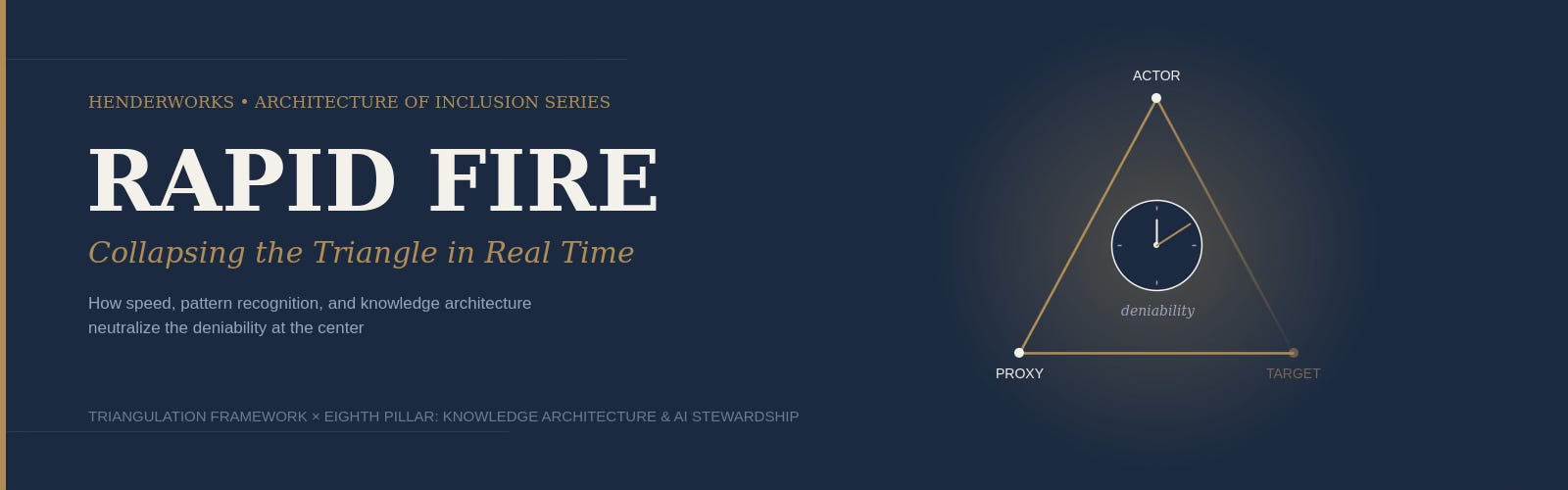
A HenderWorks Essay — Architecture of Inclusion Series × Triangulation Framework
There’s a pattern I keep noticing across every triangulated attack I’ve studied — legal, legislative, archival, cascade. The actor, the proxy, the target, the deniability at the center: all of that structure is familiar by now. But there’s an element underneath all of it that I hadn’t named directly until this piece.
Time.
Deniability isn’t a fixed advantage the actor holds. It’s a countdown. It only works in the gap between the moment a predicate is planted and the moment the target recognizes what’s happening. Widen that gap, and the false impression hardens into accepted fact. Close it, and the whole operation loses its cover — because an attack that’s visible as an attack can’t pretend to be a neutral observation anymore.
This week’s essay, Rapid Fire: Collapsing the Triangle in Real Time, is about that gap — and about building the organizational muscle to close it. It introduces the Rapid Fire Protocol as the operational counterpart to the Triangulation Framework, and connects both to the eighth pillar of the Architecture of Inclusion: Knowledge Architecture and AI Stewardship.
If you’ve been following the Triangulation Series, this is the piece where the analytical framework meets the clock.
I. The Weapon Is Not the Claim. The Weapon Is the Clock.
Every triangulated attack depends on one thing more than any other.
Not the actor.
Not the proxy.
Not even the target.
It depends on time.
The Triangulation Framework has taught us to see the structure clearly: an Actor holding power launches a claim through a Proxy Instrument — a headline, a statistic stripped of context, a legal predicate, a viral post — aimed at a Target: people, institutions, communities. And at the center of the triangle sits the mechanism that makes the whole operation work: Deniability. The actor never has to own the harm. The proxy carries it. The meaning arrives before the evidence does.
But deniability is not a permanent condition. It is a perishable one.
Deniability survives only in the gap between the moment a predicate is planted and the moment the target recognizes the pattern. Widen that gap, and the impression hardens into accepted reality. Close that gap, and the triangle collapses — because a triangulation that is named while it is happening loses its central asset. An attack that is visible as an attack can no longer pretend to be an observation.
That is why the future of this work is not only analytical. It is temporal.
The question is no longer simply “Can we see the triangle?”
The question is “How fast can we see it?”
II. From Deliberation to Disciplined Speed
For years, those of us in the work of inclusion and organizational change were trained as scholars. We read deeply. We built evidence. We constructed arguments designed to withstand scrutiny. That discipline is not obsolete. It is the foundation of what comes next.
But the information environment has changed the physics of the work.
Misinformation now travels faster than evidence. A distorted claim can shape public perception before careful analysis ever enters the room. The objective of these campaigns is rarely to educate. It is to create an impression — and once the impression takes hold, facts arrive as visitors in someone else’s house.
This is not a communications problem. It is a strategic one. And it demands a capability most institutions were never built to have: the ability to respond with both speed and precision, without sacrificing either.
Rapid response does not mean reckless response.
It means preparation converted into velocity.
Pilots do not relearn flight when turbulence hits. Emergency physicians do not study anatomy at the trauma bay. Experienced practitioners recognize dangerous conditions in seconds because years of disciplined learning have become instinct.
The same is true here. Depth of knowledge is what makes speed safe. Speed without depth is panic. Depth without speed is irrelevance. The new era requires both — fused into a single organizational competency.
III. Rapid Triangulation: Reading the Triangle While It Is Still Being Drawn
Here is the insight that changes everything: few attacks are new.
They are variations on familiar architecture. Different language, different targets, different political moments — but the underlying sequence repeats:
Create doubt. Amplify fear. Repeat the claim until it feels true. Demand surrender before analysis can occur.
When you recognize the recurrence, you stop treating every attack as unique. You see the blueprint behind it. You anticipate the next move before it arrives.
I call this rapid triangulation — the capacity to examine an emerging claim from multiple directions simultaneously and map it onto the triangle in real time:
Who is the Actor?
Not the messenger — the power behind the messenger. Who initiated this? Who benefits? Who is funding, coordinating, or sequencing it?
What is the Proxy Instrument?
What predicate is being built? Is the claim itself the point, or is the claim a vehicle — a legal foundation, a classification, a pretext being laid for a later action?
Who is the Target?
Who is meant to absorb the harm? And just as important: who is the audience — the undecided middle whose impression is the actual prize?
Where is the Deniability?
What allows the actor to disclaim the harm? What language, framing, or intermediary provides the cover?
Answer those four questions quickly, and something remarkable happens. The attack loses its most valuable property: its invisibility as an attack. You have converted an ambient narrative back into a legible operation — with authors, instruments, intended outcomes, and a center of gravity that can now be named in public.
This is not guessing. It is disciplined pattern recognition supported by deep expertise. Experience becomes acceleration.
IV. Where the Eighth Pillar Comes In
None of this is possible at the speed required without infrastructure. This is where Rapid Fire connects directly to the Architecture of Inclusion — specifically to its eighth pillar: Knowledge Architecture and AI Stewardship.
An organization cannot triangulate rapidly on memory and goodwill. It needs:
Institutional memory that is retrievable, not archival.
Evidence, precedent, prior campaigns, prior responses — organized so they can be summoned in minutes, not reconstructed in weeks.
AI-augmented sensing and analysis.
Artificial intelligence, retrieval-augmented knowledge systems, and workflow automation do not replace expertise. They amplify it. They allow judgment — human judgment — to operate at the tempo of the environment rather than the tempo of the committee calendar.
Pattern libraries.
A documented record of the triangulation forms already observed — legal, archival, legislative, cascade, oracular — so that a new event can be matched against known architecture rather than analyzed from zero.
Governance and ethics.
Because speed without integrity becomes propaganda. Technology without ethics becomes manipulation. The eighth pillar is called stewardship for a reason: the same tools that defend truth can distort it, and the difference is the discipline of the hands that hold them.
This is the marriage the moment demands: the analytical clarity of the Triangulation Framework, operating on the knowledge infrastructure of the eighth pillar, at the speed the information environment now requires.
I call that integrated capability Rapid Intelligence Architecture (RIA) — the organizational capacity to sense, analyze, validate, and respond to emerging narratives in near real time, with evidence, at scale, without surrendering judgment.
V. The Rapid Fire Protocol: The Triangle Operationalized
Philosophy becomes practice through protocol. The Rapid Fire Protocol is the repeatable discipline that turns rapid triangulation into organizational muscle. Its phases will be familiar — and deliberately so, because each one maps onto the triangle:
Identify the Trigger.
What exactly was said or done? Fact, opinion, speculation, or accusation? Never respond to assumptions. Respond only to clearly defined claims. (This isolates the Proxy Instrument.)
Identify the Players.
Who initiated, who amplifies, who benefits, who is meant to believe. (This names the Actor and the Target — and distinguishes the target of harm from the audience of impression.)
Determine the Objective.
Educate? Intimidate? Pressure leadership? Establish a legal predicate? Damage credibility? Understanding the objective changes the response. (This exposes what the Deniability is protecting.)
Assess the Evidence.
Separate evidence from assertion. Internal facts, external research, precedent, legal authority, data. Confidence should rise only as evidence rises.
Recognize the Pattern.
Have we seen this architecture before? Which triangulation form does it match? Pattern recognition shortens response time without sacrificing accuracy.
Evaluate Risk.
Legal, reputational, human, operational. Not every attack deserves the same response. Respond proportionately.
Select the Strategy.
Correct the facts. Provide context. Release evidence. Engage directly — or exercise strategic restraint. Sometimes the strongest response is immediate. Sometimes it is silence with a timestamp.
Measure Impact.
Did misinformation decrease? Did trust improve? What enters the pattern library for next time? Every rapid-fire event should make the organization smarter than the one before it.
Run in sequence, the protocol does something triangulated attacks are not designed to survive: it converts the target from an object of the operation into an analyst of the operation. The triangle only works on those who cannot see it.
VI. The New Practitioner
This moment redefines the role itself.
The future practitioner of inclusion is no longer only a trainer, a facilitator, or a policy expert. They are becoming an intelligence architect. A workflow designer. A curator of evidence. A rapid-response strategist. A steward of the knowledge systems that let truth move at the speed of its adversaries.
That transformation requires new competencies — understanding AI without surrendering judgment, using technology to accelerate wisdom rather than replace it, grounding confidence in evidence rather than ideology.
And it requires courage. Because naming a triangulation while it is happening means naming the actor behind the proxy — and actors who rely on deniability do not appreciate having it collapsed.
But this is the work now. Not winning arguments — protecting truth before misinformation becomes institutional memory. Refusing to let the false narrative write the first draft of history. Ensuring evidence has a voice equal to emotion, delivered while the conversation is still alive.
The rapid-fire age has arrived. Information will move quickly; that is no longer in question.
The only question is whether truth can move just as fast.
It can — if we build the architecture that lets it.
The triangle depends on the clock.
Take away the clock, and the triangle falls.
I am because we are. And because we are, truth does not have to arrive last.
© HenderWorks, Inc. — Architecture of Inclusion Series | Triangulation Framework