
The Algorithm Got Soul
Blackness, Diversity, Rhythm, and the Intelligence of Many

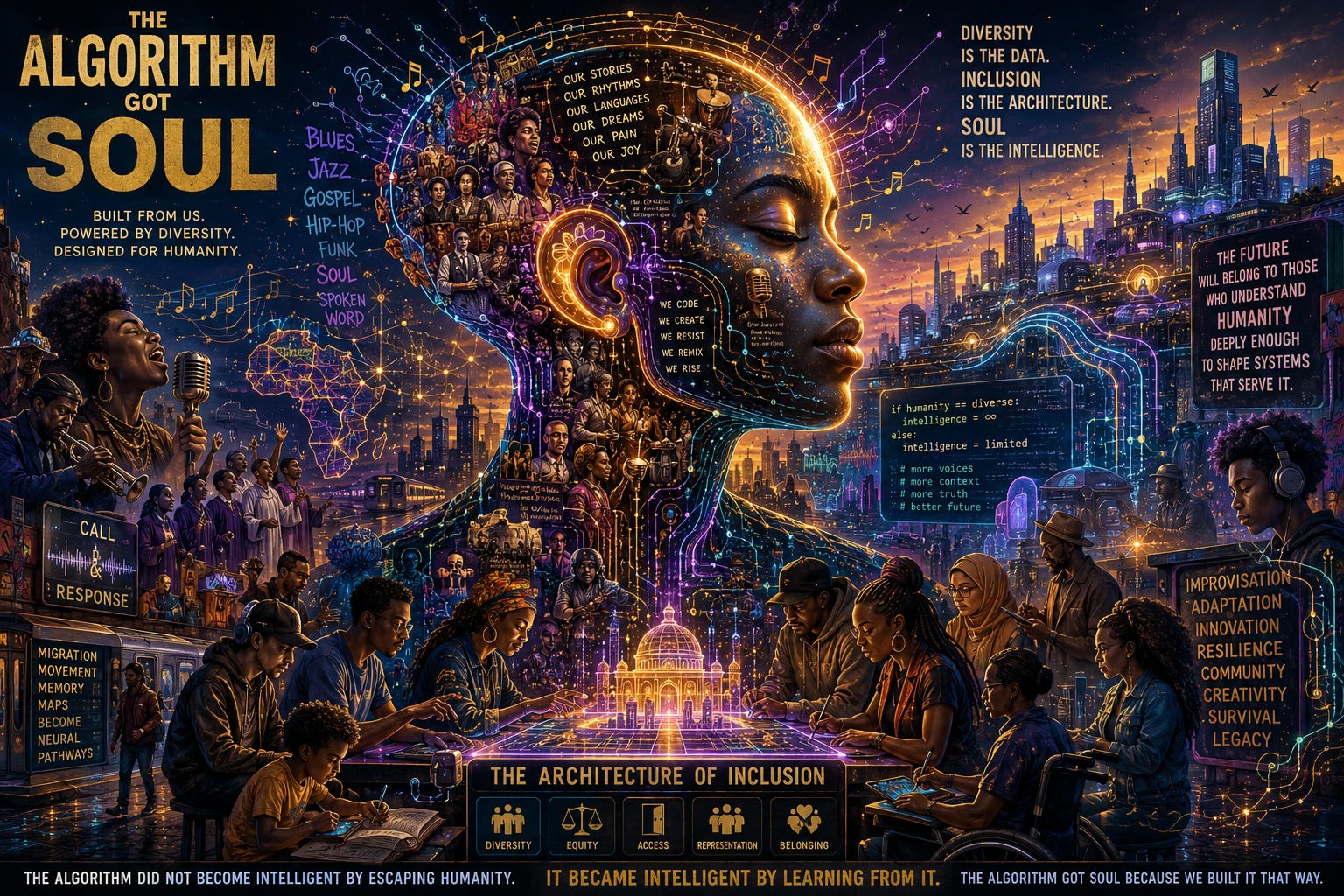
There is a misunderstanding taking shape in modern society.
Some people believe artificial intelligence is detached from humanity.
Cold. Mechanical. Neutral.
But the deeper truth is this:
AI is built from us.
From our language.
Our stories.
Our contradictions.
Our rhythms.
Our migrations.
Our inventions.
Our pain.
Our joy.
Our music.
And if you strip away diversity from artificial intelligence, you strip away the very thing that makes it intelligent.
At its core, AI is pattern recognition. It learns from enormous oceans of human behavior, communication, creativity, and interaction. The broader the human experience it can learn from, the more adaptive, nuanced, and capable it becomes.
That means diversity is not a side issue in AI.
Diversity is the fuel.
And within that story sits something foundational: Blackness.
Not merely as race, but as contribution.
As improvisation.
As adaptation.
As cultural invention.
As rhythm and resilience.
From blues to jazz.
From gospel to hip-hop.
From funk to soul.
From spoken word to coded language born from survival and creativity.
Black culture has long operated as one of humanity’s greatest pattern generators.
Improvisation.
Call and response.
Remix culture.
Emotional intelligence.
Adaptive survival.
Communal storytelling.
These are not peripheral to AI-era thinking.
They are central to it.
The same world that sometimes attempts to marginalize diversity simultaneously feeds its algorithms with the products of diverse humanity every single day. The music. The slang. The dance. The aesthetics. The emotional cadence. The cultural invention.
AI learns because humanity differs.
Difference is the dataset.
And when organizations or societies attempt to erase diversity, silence voices, or narrow participation, they are actually reducing the intelligence capacity of the systems they claim to want to advance.
Homogeneity weakens intelligence.
Pluralism expands it.
That is true in democracy.
True in organizations.
True in science.
True in music.
And true in AI.
The future of artificial intelligence will not belong solely to engineers.
It will belong to those who understand humanity deeply enough to shape systems that can navigate complexity, contradiction, culture, emotion, and ethics.
That means the future requires artists.
Poets.
Storytellers.
Historians.
Anthropologists.
Musicians.
Communities.
And people whose lived experiences were once pushed to the margins.
The irony is profound:
The very groups some seek to erase from institutional visibility are often the groups whose creativity most powers modern cultural intelligence.
So when we talk about diversity in AI, we are not talking about charity.
We are talking about capability.
We are talking about design intelligence.
We are talking about civilizational sustainability.
The algorithm got soul because humanity put it there.
And if we want AI to serve mankind rather than narrow it, surveil it, or weaponize it, then the architecture of inclusion must remain embedded in the systems we create.
Because the machine can only become as wise as the humanity it learns from.
⸻
Interesting insights: https://youtu.be/Wg0s4BLa-kA?si=VpAbuS1U2Io-V3-t