
The Merit Predicate
How a Purge Wears the Language of Excellence

They struck four names from a promotion list. Two Black men. Two women. And when the Army’s top general refused to do the striking, they struck him too.
All of it done in the name of “merit.”
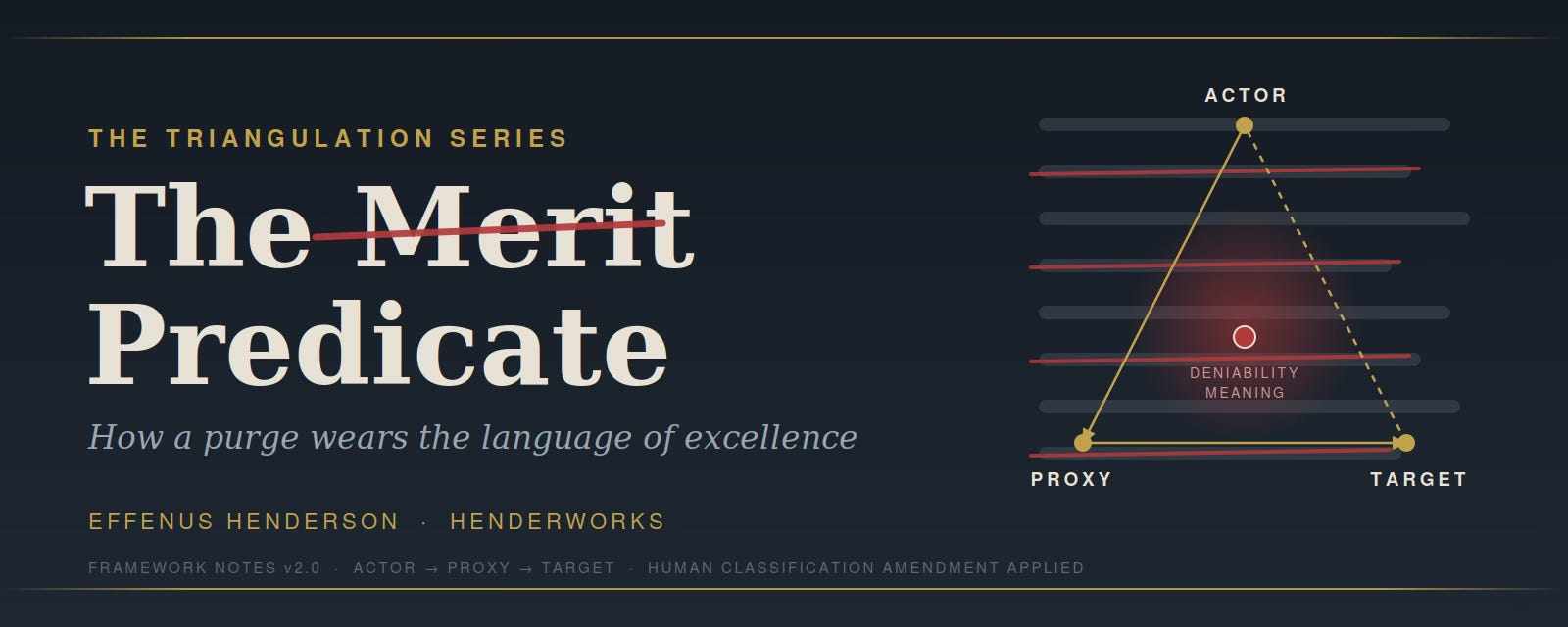
In the newest installment of the Triangulation Series, I apply the Actor → Proxy → Target frame to the ongoing purge of senior military leadership — more than two dozen generals and admirals forced out, dozens more blocked from promotion, roughly sixty percent of them Black or female. The pattern reveals something more sophisticated than hypocrisy: a captured word doing the work of a predicate. You cannot install favor-based selection while merit machinery still functions. So the machinery is being dismantled — in merit’s own name.
The essay walks through the full frame: the actor who cannot say the quiet part, the twin proxies (a word and a memo), the true target (not the officers removed, but the tens of thousands who remain and now govern themselves), and the deniability engineered at the center. It closes with what the frame predicts next — including the phase I call retroactive redefinition. Watch for it.
When the proxy word and the observable behavior point in opposite directions, the behavior reveals the motive. The word reveals the strategy.
I. The Claim and the Conduct
An administration that speaks constantly of meritocracy is presiding over the most sweeping demographic purge of senior military leadership in modern American history. Over roughly eighteen months, the Secretary of Defense has forced out more than two dozen general and flag officers and reportedly blocked or delayed the promotions of dozens more. Reporting from multiple outlets, drawing on more than a half-dozen U.S. officials, indicates that promotions for more than a dozen Black and female senior officers were blocked or delayed across all four service branches. Analysts reviewing the removals have noted that roughly sixty percent of those pushed out have been Black or female — in an officer corps where those groups remain a distinct minority at flag rank. The disproportion is not subtle. It is statistical shouting.
The names carry meaning beyond the individuals. General CQ Brown, only the second African American to chair the Joint Chiefs. Admiral Lisa Franchetti, the first woman to lead the Navy. Vice Admiral Shoshana Chatfield, the only female flag officer on NATO’s Military Committee. Vice Admiral Yvette Davids, the first female superintendent of the Naval Academy, relocated from her post. Admiral Linda Fagan, the first woman to lead a branch of the armed forces, removed in the administration’s opening days. Each was a first. Each is now a former.
And in April 2026, the frame snapped into perfect focus: the Army Chief of Staff, General Randy George — a white male combat veteran — was himself forced into retirement after, according to reporting, he refused an instruction to strike four officers from a promotion list. Two Black men. Two women.
A list. An instruction. Four names to be struck by category.
The Triangulation Framework exists for moments exactly like this one — when the stated reason and the observable pattern point in opposite directions, and the distance between them is doing the work.
II. The Frame Applied
The Triangulation Framework maps coordinated operations across three vertices — the Actor who holds power, the Proxy Instrument through which power moves, and the Target upon whom it lands — with Deniability and Meaning occupying the center, where the operation’s true signal is transmitted while its authorship is disclaimed.
The Actor. The Secretary of Defense, acting with the administration’s full blessing and stated ideological program. The actor has been explicit about the worldview: he has called the phrase “our diversity is our strength” the dumbest in military history. What the actor has never said — what the actor structurally cannot say — is “we are removing Black officers and women.” The operation depends on that sentence remaining unspoken. Everything else in the design flows from the need to accomplish that outcome without uttering that sentence.
The Proxy Instrument. Here the case becomes a landmark specimen, because the proxy is not a policy or a statute. The proxy is a word — merit — and the word is running in tandem with a structural instrument that hollows out merit’s actual machinery.
The rhetorical proxy is the merit/lethality/anti-woke vocabulary. It functions as a predicate in the fullest Framework sense: a pre-constructed justification category into which any removal can be sorted after the fact, requiring no evidence in the individual case. Under this predicate, an officer’s demographic identity or past association with inclusion initiatives is the evidence. The accusation and the identity collapse into one another. That collapse is not a flaw in the predicate. It is the predicate’s function.
The structural proxy is quieter and more consequential. A May 2025 memo directed senior leadership to slash the number of general and flag officers — framed as streamlining, a facially neutral administrative act. Officer promotion boards, statutory tenure protections, professional evaluation systems — these are the military’s merit-assessment architecture, refined across generations precisely so that advancement would rest on documented performance rather than personal favor. The actor claims merit while personally intervening in promotion lists, overriding board outcomes, and firing the service branches’ top uniformed lawyers — the referees positioned to name the operation as unlawful. One official told reporters that no service has been immune from this level of secretarial involvement in promotions.
Read the two proxies together and the design is visible: you cannot install favor-based selection while merit machinery still functions. So the machinery must be bypassed and discredited — in merit’s own name. The word is deployed to destroy the thing the word describes. This is proxy capture in its most complete form: the operation does not merely borrow neutral language, it seizes the opposition’s central term and inverts it, so that anyone defending actual merit systems can be accused of opposing merit.
The Target. The immediate targets are the named officers — disproportionately Black, brown, and female, along with the judge advocates general and intelligence leaders who constituted the accountability layer. But the Framework insists we look past the immediate casualties to the intended audience. The true target is the surviving officer corps: the tens of thousands of professionals now recalibrating their careers around a demonstrated rule set. Two former officers, speaking anonymously to protect their pensions, have described being forced out simply for questioning command decisions. The lesson lands on everyone who remains: visibility is risk, candor is risk, identity is risk. A purge does not need to remove every officer it means to control. It needs only to remove enough of them, visibly enough, that the rest govern themselves.
The Center: Deniability and Meaning. Every removal arrives wrapped in institutional gauze — “loss of confidence,” “streamlining,” “retirement effective immediately,” gratitude for decades of service. The Pentagon’s official posture is flat denial that any officer has been dismissed for raising concerns. And yet the meaning transmits with total clarity. Reporting describes an atmosphere of anxiety and mistrust settling across the department. This is the deniability/meaning split operating exactly as the Framework predicts: plausible innocence manufactured for external and legal audiences, unambiguous signal delivered to internal ones. The denial is not meant to be believed inside the building. It is meant to be quotable outside it.
III. The Sorting Layer, Made Literal
Framework Notes v2.0 introduced the Human Classification amendment — the recognition that triangulation operations increasingly run through a sorting layer, where human beings are classified into categories before power acts upon them, so that the action can be attributed to the category rather than the chooser.
The April promotion-list incident is the sorting layer stripped of all metaphor. A physical list of names. An instruction to strike four of them. The four identifiable by race and gender. A senior officer who refused to perform the sort — and was then sorted out himself. It may be the cleanest documented instance of the classification layer this series has catalogued: the sorting was not algorithmic, not statistical, not buried in policy language. It was a hand, a list, and four names. When General George declined to be the hand, the operation simply found another one — his replacement reportedly poised to be the Secretary’s own former military aide.
That final detail matters, because it supplies the inversion test.
IV. The Inversion Test
If merit were genuinely the operating standard, we would observe three things: articulated performance criteria, case-by-case justifications, and replacements whose records demonstrably exceed those they replace. Instead we observe no stated reasons, demographic clustering that defies chance, statutory terms cut short, and a personal aide positioned to succeed a four-star chief. Bipartisan concern has emerged in Congress precisely because the pattern is legible even to the actor’s own party — legible enough that some Republican lawmakers are now debating guardrails on the Secretary’s removal authority.
When the proxy word and the observable behavior point in opposite directions, the behavior reveals the motive and the word reveals the strategy. That is the Framework’s core diagnostic, and this case passes it decisively. Merit is not the standard here. Merit is the alibi.
V. What the Frame Predicts
Triangulation operations of this design tend to move through predictable phases, and this one is mid-arc. First comes the removal of symbolic firsts, establishing the pattern while deniability is freshest. Then the dismantling of assessment machinery, so that the pattern cannot be measured against a functioning baseline. Then the removal of referees — the lawyers, the inspectors, the institutional memory. Then the installation of personal loyalty as the unstated but operative criterion. The final phase is the one to watch for: the retroactive redefinition, in which the gutted system’s degraded outcomes are cited as proof that the old merit machinery never worked — completing the inversion by blaming the demolished structure for the wreckage of its demolition.
The defense against a captured word is not to abandon the word. It is to re-anchor it in the systems, evidence, and documented processes that gave it meaning — and to name, precisely and publicly, the distance between the predicate and the pattern. That naming is what this series exists to do.
The officers struck from that list had names. The system that assessed their merit had a history. Both deserve better than to be erased by the very word they honored.
I am because we are. And because we are — we keep the record, we name the sort, and we refuse the alibi.
© 2026 HenderWorks, Inc. | The Triangulation Series | Framework Notes v2.0: Actor → Proxy Instrument/Predicate → Target, with Deniability/Meaning at the center. Human Classification amendment applied.