
Where the Cascade Lands
Dewey City, the Eightieth Community, and the Target Vertex of the Triangle

THE TRIANGULATION SERIES
By Effenus Henderson | HenderWorks, Inc. | July 2026
I. The Creek
Oquina Creek runs along the edge of Dewey City, a neighborhood in Thomasville, Georgia, established after the Civil War as the first place in that city where Black residents could build homes. For generations, Black congregations walked down to that water to baptize their members. The creek was where the community marked its beginnings — where welcome was made physical.
Today the creek carries fecal bacteria and other contaminants, fed by runoff and a municipal wastewater system that is roughly eighty-two years old. Homes nearby stand with mold-covered siding, boarded windows, holes in roofs — housing stock that decades of redlining and disinvestment left saturated with lead paint and asbestos that residents cannot afford to remove. Earl Williams, who grew up there and returned after thirty years away to help revitalize it, told KFF Health News that at times “you get the feeling like you’re in a Third World country.”
In 2024, this was finally going to change. Thomasville and the Thomasville Community Development Corporation won a $19.8 million Community Change Grant from the Environmental Protection Agency — part of a two-billion-dollar national program to help disadvantaged communities address environmental health risks. The Restoring Resiliency project would repair the wastewater system, remove the lead, mold, and asbestos from aging homes, and convert part of the shuttered Douglass High School — the first public school for Black students in Thomasville, opened in 1902 — into a neighborhood health clinic, in a community of older residents for whom the trip across town for care has never been simple.
Three months after winning the grant, Thomasville lost it. So did seventy-nine other communities across the country, from Hawai‘i to Alabama to Massachusetts, when the new administration canceled the funding under a day-one executive order targeting what it called radical and wasteful DEI programs and preferencing. An agency spokesperson explained that environmental-justice preferencing falls outside the EPA’s core mission of protecting human health and the environment.
Sit with that sentence for a moment. A grant to repair a sewage system, strip lead paint from homes, and open a health clinic was canceled on the stated ground that it fell outside the mission of protecting human health and the environment. This essay is about how a sentence like that becomes possible — and why no one who made it happen will ever be identifiable as the person who decided that the children of Dewey City should keep living with lead.
The Issue illustrated in lyrics and music by HenderWorks
II. The Series Reaches the Third Vertex
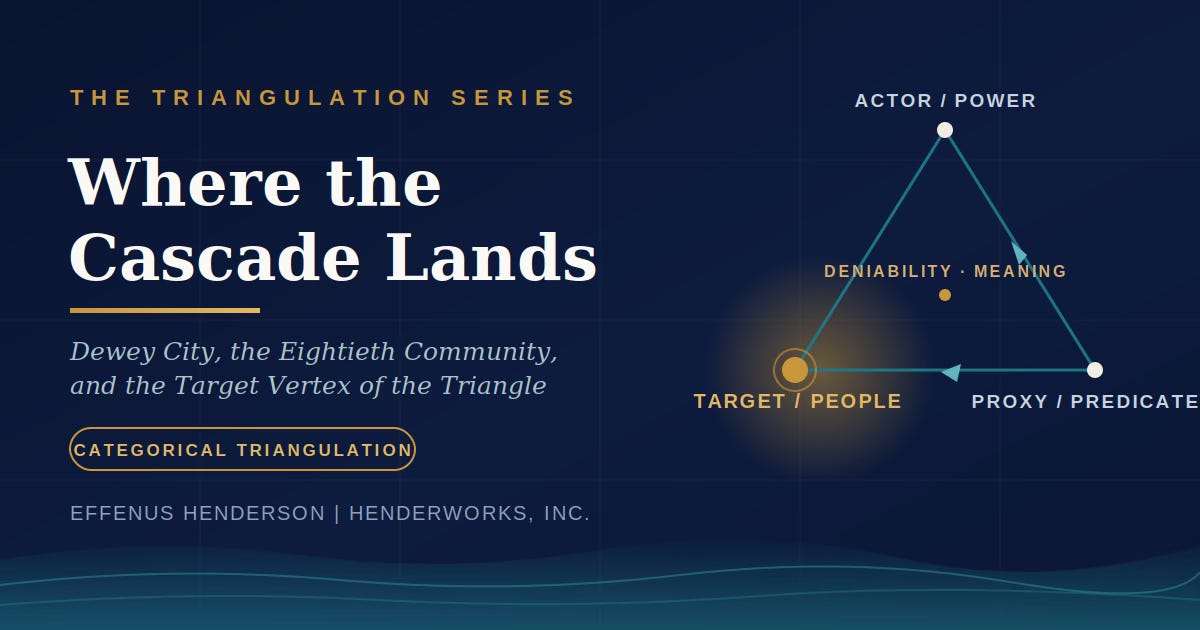
Every previous essay in this series has documented an instrument. We have examined the audit report that orders nothing and coerces everything, the data instruction that stops the counting, the enforcement action whose real audience is the thousand institutions never sued. The triangle — Actor, Proxy Instrument, Target, with Deniability and contested Meaning at its center — has been mapped mostly from its first two vertices, because that is where the operations are visible.
Dewey City is the third vertex. This is where the cascade lands: not in a courtroom or a compliance office but in a creek, a roofline, a band room that was supposed to become a clinic. The Target layer of the framework is not an abstraction called “affected populations.” It is a specific older resident who did not get vaccinated during the pandemic until Black nurses offered shots at First Missionary Baptist Church, because trust is also infrastructure, and it was the piece of infrastructure the clinic was designed to honor.
If the series has an obligation, it is to stand at this vertex at least as often as it stands at the others. Instruments are interesting. People are the point.
III. Categorical Triangulation: Sort the Place, Defund the Sort
Run the Dewey City case through the framework and a new form comes into focus — one this essay will name categorical triangulation.
The Actor never names the Target. No federal official decided anything about Dewey City. The neighborhood appears in no executive order, no agency memorandum, no press statement. The decision that reached it was made about a category.
The Proxy Instrument is the reclassification itself. First, environmental justice — a body of work about sewage, lead, asbestos, and clinic access — is reclassified as “DEI preferencing.” Then the category, not any community, is defunded. The sorting operation this series identified in Framework Notes v2.0 as Human Classification here operates at neighborhood scale: sort the places into a bin, then target the bin. No individual harm is ever decided; a label is retired, and the harm follows the label home.
The Deniability is arithmetic. Eighty communities lost funding at once. That breadth is not incidental to the deniability — it is the deniability. When one community is defunded, someone chose it. When eighty are defunded by category, no one chose any of them. Breadth launders specificity. The wider the cut, the cleaner every hand involved.
And the Meaning contest at the center of this triangle is unusually pure. The agency’s stated justification — that equity preferencing sits outside the core mission of protecting human health and the environment — invokes the mission as the ground for withdrawing a grant whose entire content was human health and the environment. Previous essays documented predicates that conceal their payload inside neutral language. This predicate wears the payload as its justification. The mission statement is deployed as the instrument against the mission. That inversion is not sloppiness. In a legitimacy conflict, capturing the meaning of an institution’s own charter is the highest-value terrain there is.
IV. The Claw-Back and the Cascade Creditors
One detail separates this case from an ordinary funding decision, and it deserves its own section: the grant was not declined. It was awarded, and then revoked — three months after Thomasville won it, after plans were drawn, after a community that has been promised things before allowed itself to believe this promise.
A refusal says no. A claw-back teaches. Its audience is not Thomasville; it is every community development corporation in the country now calculating whether federal partnership is worth the risk of building real plans around money that can vanish retroactively. The lesson lands hardest on exactly the organizations with the least slack to absorb it — small, trusted, neighborhood-scale institutions like the one Earl Williams served. This is the Cascade Creditors mechanism the series identified in Framework Notes v2.0, collecting at the grassroots layer: downstream actors absorb the risk, internalize the caution, and quietly stop applying, stop planning, stop believing. The example is the enforcement — and this time the example is a neighborhood.
Watch for the cascade’s next step, because it is predictable: future analyses will observe that disadvantaged communities “failed to seek” federal support, and the record of why will have been laundered through their own rational withdrawal. The triangle’s cruelest efficiency is that it eventually persuades its targets to do its work for it.
V. Why This Is Triangulation — the Discipline Check
This series has committed to classification discipline: not every exercise of power against a community is triangulation, and the framework loses its diagnostic value the moment it becomes a synonym for “things I oppose.” Field Note No. 1 established the counter-category — cases where power acts openly on a named target and hides nothing.
Dewey City passes the test. The racial geography of the harm is total: a post-Civil-War Black neighborhood, shaped by documented redlining, whose landmark institutions are a segregated-era school and the churches that baptized in the creek. Yet nothing in the instrument names race, place, or people. The harm is routed entirely through facially neutral category membership — “environmental justice grantee” — and every official involved can truthfully say they never made a decision about Dewey City. Truthfully, and meaninglessly. That gap between the truth of the statement and the meaning of the act is the signature this series exists to read. When power doesn’t hide, we say so. This is not that. This is the triangle, textbook-clean.
VI. The Moral Level Runs Through the Creek
I served three years on the EPA’s National Environmental Justice Advisory Council. I sat in the rooms where the architecture behind programs like the Community Change Grants was debated, and I can attest to what the record shows: environmental justice was never a preference regime. It was a correction mechanism — an acknowledgment that the burdens of contamination and the benefits of remediation had been distributed by history with brutal precision, and that a nation serious about its own stated mission would route repair toward the places repair was owed. Reclassifying that work as “preferencing” does not describe it. It erases the history that made it necessary — which is, of course, the point. A country that cannot name why Dewey City’s wastewater system is eighty-two years old cannot be asked to fix it.
Essay Zero of this series argued that the moral level of conflict is decisive, and warned against answering an architecture of exclusion with a mirrored siege. Dewey City shows what holding the moral level actually looks like, because the community is already doing it: municipal leaders appealing the decision, the development corporation piecing together smaller grants for basic repairs, a commissioner-pastor describing the project as a long attempt to bend the arc of justice closer, neighbors continuing the historical walks that insist the place be remembered as more than its damage. That is not resignation. It is the patient, public, accountable construction this series keeps pointing toward — carried on by the people with the least resources and the most standing.
The creek is the image I cannot put down. Water that once meant welcome — the physical sacrament of belonging to a community — now means hazard, and the money that would have restored it was withdrawn in the name of protecting human health and the environment. If you want to know what the center of the triangle looks like when the abstraction is stripped away, it looks like that: a baptismal creek you cannot touch, and no one anywhere who decided it should stay that way.
VII. What Is Owed
Three obligations follow. First, name the form. Categorical triangulation — sort the place, defund the sort — now joins the series taxonomy, and it should be recognized on sight the next time a category is retired and eighty communities absorb the consequence no one ordered. Second, keep the ledger. The claw-back strategy depends on the harms dispersing into local stories too small to aggregate; the answer is documentation that refuses dispersal — eighty communities, one pattern, one record. The reporting by KFF Health News that brought Dewey City’s story to national attention is exactly this ledger-keeping, and analytical work like this series is downstream of journalism like that. Third, stand at the third vertex. Policy analysis that never touches ground participates, gently, in the same abstraction the triangle depends on. The people of Dewey City are not a case study. They are the reason the framework exists.
The cascade will keep moving. Our work is to make sure that wherever it lands, it lands named.
I am because we are. And because we are…
Sources and Notes
Source journalism: Lumpkins, B., KFF Health News (2026). “EPA Grants for Public Health Improvements Stall in Trump DEI Crackdown” (also published via States Newsroom): kffhealthnews.org/public-health/epa-grants-public-health-improvements-stall-trump-dei-crackdown-georgia/. All factual details about Dewey City, the Restoring Resiliency project, the grant award and cancellation, and quoted community voices derive from this reporting, which deserves full credit.
Federal actions referenced: Executive Order, “Ending Radical and Wasteful Government DEI Programs and Preferencing” (January 2025); EPA Community Change Grants program (approx. $2 billion, established under the Inflation Reduction Act during the Biden administration); cancellation affecting approximately 80 community grants nationwide.
Framework references: Triangulation Framework and Framework Notes v2.0, including the Human Classification and Cascade Creditors amendments; “Essay Zero: The Doctrine Was Published in 1989” (moral-level analysis); Triangulation Field Note No. 1, “When Power Doesn’t Hide” (classification discipline).
New taxonomy term introduced in this essay: categorical triangulation.
Author’s note: The author served three years on the EPA’s National Environmental Justice Advisory Council (NEJAC).
© 2026 HenderWorks, Inc. | The Triangulation Series | henderworks.com