
ZERO-SUM FALLACY: How the Myth of Scarcity Fuels Attacks on Voting Rights and Diversity
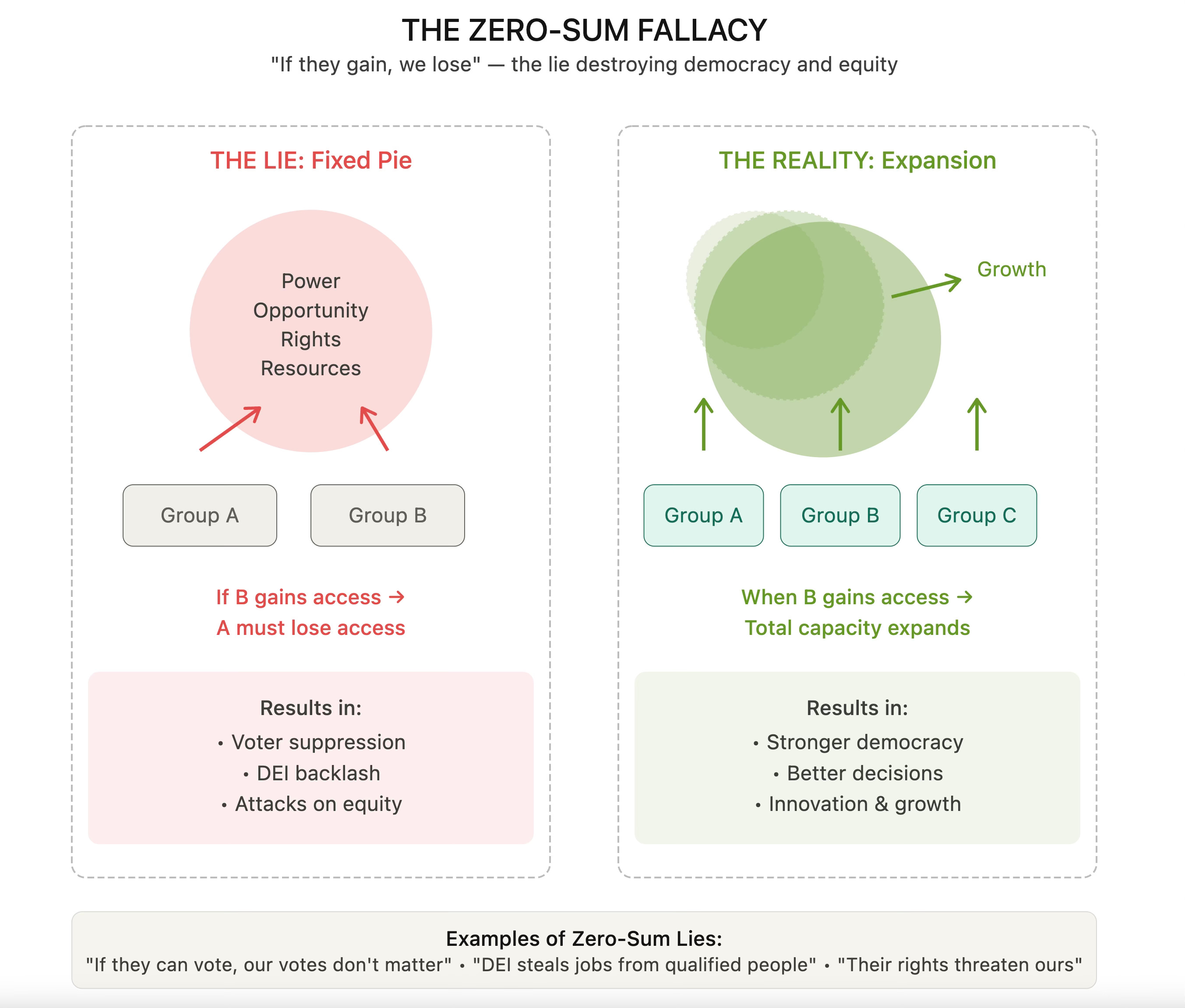
"If they gain, we lose" - the lie destroying democracy and equity

By Effenus Henderson
INTRODUCTION: THE MATHEMATICS OF FEAR
There is a lie at the heart of the current assault on voting rights and diversity, equity, and inclusion. It is a simple lie, almost mathematical in its brutality: If they gain, we lose.
This is the zero-sum fallacy—the belief that justice, opportunity, and political power exist in fixed quantities, such that any extension of rights to those historically excluded must come at the expense of those who have always had them. It is the conceptual foundation beneath the Supreme Court’s gutting of the Voting Rights Act, the coordinated campaign against corporate DEI programs, and the legislative rush to ban diversity initiatives in education and government.
The fallacy operates with seductive clarity: There are only so many seats at the table, only so many votes that matter, only so many opportunities to go around. When someone new sits down, someone else must stand up. When a voice long silenced finally speaks, someone else must be muted. When power shifts even slightly toward those who have been systematically excluded, it can only mean that power has been taken from those who held it.
But this is not mathematics. This is mythology.
And it is a mythology with devastating consequences—because when people believe the lie of scarcity, they fight to protect what they imagine they are losing, even when expansion, not subtraction, is what’s actually occurring.
This essay examines how zero-sum thinking operates in two critical domains—voting rights and diversity initiatives—and why this framing is not just wrong, but dangerous. It shows how the zero-sum fallacy transforms gains in equity into perceived threats, remedies for exclusion into acts of discrimination, and progress toward multiracial democracy into existential crises requiring aggressive rollback.
Most importantly, it argues that exposing the zero-sum fallacy is not merely an intellectual exercise—it is a prerequisite for defending democracy itself.
PART 1: UNDERSTANDING ZERO-SUM THINKING
What Is Zero-Sum?
In game theory and economics, a zero-sum game is one in which one participant’s gain is exactly balanced by another participant’s loss. The total amount of benefit remains constant—it simply changes hands.
Classic example: Poker. The total money in the pot is fixed. Whatever I win, you lose. The sum of all gains and losses always equals zero.
In social and political contexts, zero-sum thinking assumes:
Resources (power, opportunity, status) are fixed and finite
Any gain by one group necessitates loss by another
Equality is a threat to those currently advantaged
Justice for the excluded comes at the expense of the included
Social progress is redistribution, not expansion
The critical error: Most social goods are NOT zero-sum. Voting rights, economic opportunity, educational access, dignity, justice—these can expand. One person’s gain does not require another’s loss.
Yet zero-sum thinking persists because:
It’s intuitive (scarcity feels real)
It protects status quo power arrangements
It’s politically useful (mobilizes fear and resentment)
It’s historically embedded in American racial politics
The Historical Roots: Zero-Sum as White Supremacist Logic
Zero-sum thinking about race in America is not new—it is foundational.
Slavery’s Logic: The entire institution rested on a zero-sum premise: white prosperity required Black subjugation. Freedom for the enslaved was framed as economic catastrophe for the South. The Civil War was fought, in part, because Southern whites could not imagine prosperity without the zero-sum extraction of Black labor.
Reconstruction’s Betrayal: When newly freed Black Americans gained voting rights, white Southerners responded with terror because they understood political power as zero-sum. Black enfranchisement was treated as white disenfranchisement—not because white people lost the right to vote, but because their votes were no longer the only ones that mattered.
The result: a century of Jim Crow, built on the premise that Black political power was incompatible with white security.
Civil Rights Backlash: The same logic animated resistance to Brown v. Board (school desegregation), the Civil Rights Act, and the Voting Rights Act. White parents didn’t lose education when Black children entered “their” schools—but they believed they did, because they understood quality education as a scarce resource requiring exclusion to maintain.
The Pattern: Every major expansion of rights in American history has been met with backlash rooted in zero-sum fear—the fear that equality diminishes those who previously held monopoly access to power, opportunity, and dignity.
And today’s attacks on voting rights and DEI are simply the latest iteration of this centuries-old pattern.
PART 2: ZERO-SUM AND THE ASSAULT ON VOTING RIGHTS
The Supreme Court’s Zero-Sum Framework
When the Supreme Court gutted the Voting Rights Act in Shelby County v. Holder (2013) and more recently struck down Louisiana’s majority-Black congressional district (2026), it did so by embedding zero-sum logic into constitutional doctrine.
The Court’s Implicit Framework:
Preclearance for some states = punishment of those states (ignoring that it was protection for voters in those states)
Majority-minority districts = discrimination against white voters (treating remedy for exclusion as exclusion itself)
Race-conscious redistricting = racial preference (collapsing distinction between subordination and remedy)
The Zero-Sum Translation: If Black voters gain the ability to elect representatives of their choice, white voters must be losing something equivalent.
But this is false.
Creating a majority-Black congressional district in Louisiana doesn’t take away white Louisianans’ right to vote. It doesn’t reduce their representation to zero. It doesn’t disenfranchise them. It simply means that the state’s congressional delegation will more accurately reflect the state’s actual population.
Louisiana is 32% Black. Under the previous map: 1 of 6 seats (17%) was majority-Black. Under the Section 2 remedy: 2 of 6 seats (33%) would be majority-Black—proportional to the population.
This is not white loss. This is Black gain toward parity.
But the Court framed it as discrimination because it accepted the premise that political representation is zero-sum—that ensuring Black Louisianans can elect representatives means white Louisianans are being denied equal protection.
The Voter Suppression Playbook: Zero-Sum in Action
Post-Shelby County, states previously covered by the Voting Rights Act rushed to implement voting restrictions. The justifications were always framed in race-neutral terms—preventing “voter fraud,” ensuring “election integrity”—but the zero-sum logic was clear:
The Underlying Message: “When everyone votes, our votes don’t count as much.”
Let’s examine how this plays out:
Example 1: Voter ID Laws
Stated Purpose: Prevent voter fraud
Actual Effect: Disproportionately disenfranchise Black, Latino, elderly, low-income, and disabled voters who are less likely to have required IDs
Zero-Sum Logic at Work:
Proponents don’t say, “We want fewer Black people to vote.” They say, “We want to protect the integrity of your vote.”
Translation: Your vote only matters if it’s not diluted by those votes.
The Fallacy: Voting rights are not zero-sum. Making voting more accessible to historically disenfranchised communities doesn’t make your vote worth less. It makes democracy more representative. The “integrity” being protected is not electoral—it’s the integrity of white political dominance.
Evidence:
In-person voter fraud (the type ID laws prevent) is virtually non-existent—31 credible cases out of 1 billion votes cast (2000-2014)
Voter ID laws reduce turnout by 2-3 percentage points, disproportionately among minorities
States with strictest ID laws have no better “election integrity” than those without
Reality: These laws don’t protect voting—they restrict it. And they do so by activating zero-sum fear: “If they vote more easily, your vote means less.”
Example 2: Polling Place Closures
The Numbers:
1,688 polling places closed in previously VRA-covered jurisdictions between 2013-2018
Closures concentrated in Black and Latino neighborhoods
Creates longer lines, travel burdens, suppresses turnout
Stated Justification: Cost savings, efficiency
Zero-Sum Logic: Resources (polling locations, election budgets) are scarce. Maintaining easy voting access for everyone is too expensive. Therefore, we must reduce access somewhere—and that somewhere just happens to be in minority communities.
The Fallacy: Voting access is not a zero-sum resource allocation problem. States that maintain robust polling infrastructure don’t run out of voting capacity in white suburbs when they also provide it in Black neighborhoods. This is deliberate resource restriction disguised as scarcity.
Example: In 2018, Dodge City, Kansas (60% Latino) had one polling place for 13,000 registered voters—located outside city limits with no public transportation access. Meanwhile, nearby majority-white areas had multiple, convenient locations.
This isn’t scarcity. This is engineered disenfranchisement.
Example 3: Attacks on Early Voting and Sunday Voting
The Pattern: States cut early voting hours and eliminate Sunday voting—particularly targeting “Souls to the Polls” programs that mobilize Black churches.
Stated Justification: Reduce costs, standardize voting
Zero-Sum Logic: “If they get extra opportunities to vote (early voting, Sunday voting), that’s an unfair advantage over us.”
The Fallacy: Early voting is available to everyone. When it’s expanded, everyone benefits. Sunday voting doesn’t give Black voters “extra” votes—it gives them access despite work schedules and transportation barriers that disproportionately affect them.
Eliminating Sunday voting doesn’t make voting more equal—it makes it less accessible for those with the fewest resources.
But opponents frame it as “special treatment” because they see voting access as zero-sum: “If you make it easier for them, you’re making my vote count less.”
Reality: Making voting more accessible to more people strengthens democracy. Period.
The Redistricting Battle: Political Power as Zero-Sum
Congressional redistricting is the domain where zero-sum thinking is most explicit—because representation actually is a fixed quantity. A state has X congressional seats. How they’re drawn determines who gets represented.
This is where zero-sum logic has a foothold in reality—but it’s weaponized dishonestly.
The Legitimate Zero-Sum Element
Congressional seats ARE limited. Louisiana has 6. How you draw district lines determines:
Which communities are grouped together
Which voices are amplified
Whose interests get prioritized
In this sense, redistricting is zero-sum: A district that elects a representative responsive to Black voters is one that doesn’t elect a representative responsive to white voters.
But here’s where the dishonesty enters:
The Dishonest Framing: “Race-Neutral” as Default
When the Supreme Court struck down Louisiana’s second majority-Black district, it framed the decision as preventing discrimination.
The Court’s Logic: Using race to draw districts = discrimination
The Reality: There is no such thing as “race-neutral” redistricting in a society with residential segregation.
Why?
Because residential patterns aren’t natural—they’re the product of:
Redlining (federal policy 1934-1968)
Restrictive covenants
Discriminatory lending
Highway construction through Black neighborhoods
School segregation reinforcing residential segregation
When you draw districts “just following natural communities” or “respecting county lines,” you’re encoding historical discrimination into political representation.
So the real zero-sum question isn’t: “Should we use race in redistricting or not?”
It’s: “Should political power reflect actual population demographics, or should it preserve historical white political dominance?”
The Court chose the latter—and called it fairness.
Why Majority-Minority Districts Aren’t “Reverse Discrimination”
The Argument Against: Creating majority-Black districts treats race as determinative of political interest, discriminates against white voters in those districts, and assumes Black voters need their own districts to be represented.
Why This Is Wrong:
First: Race correlates with political interest in America because racism has created distinct policy impacts.
Criminal justice reform affects Black communities disproportionately
Voting rights protections matter most to communities targeted for suppression
Healthcare access, environmental justice, educational equity—all have racial dimensions because structural racism has created racial disparities
Black voters vote cohesively not because of racial essentialism, but because they face shared systemic barriers.
Second: White voters aren’t discriminated against in majority-Black districts—they still vote, their votes still count.
What they lose is guaranteed political dominance. That’s not discrimination—that’s equality.
Third: The “need” for majority-minority districts exists because of white bloc voting that consistently defeats Black voters’ preferred candidates.
If white voters stopped bloc voting against Black candidates, majority-minority districts wouldn’t be necessary. But as long as racially polarized voting exists (and it does—the data is overwhelming), majority-minority districts are a remedy for vote dilution.
The Supreme Court is essentially saying: “White voters can bloc-vote to prevent Black voters from ever electing their preferred candidates, but Black voters cannot have districts drawn to counteract this—because that would be racial discrimination.”
That’s not colorblindness. That’s protection of white political power.
The Zero-Sum Mobilization: White Racial Resentment as Political Strategy
Here’s what scholars of racial politics have found:
Zero-sum thinking about race is most intense among white Americans who:
Perceive their group status as threatened
Believe resources are scarce and competition is intense
See gains by people of color as necessarily coming at their expense
And this belief is politically mobilized.
Research by Michael Tesler, Ashley Jardina, and others shows:
White racial resentment (the belief that Black Americans get undeserved advantages) is the strongest predictor of opposition to voting rights expansion
Perceptions of racial “zero-sum competition” predict opposition to policies that benefit minorities—even when those policies also benefit the white respondent
Framing a policy as helping Black Americans makes white Americans less likely to support it, even if they’d support the identical policy framed neutrally
The Political Strategy:
Politicians activate zero-sum racial framing to mobilize white voters:
Dog-whistle version: “They want to change the rules so your vote doesn’t count anymore.”
Explicit version (increasingly common): “Democrats want to replace you with illegal immigrants who’ll vote for them.” (Great Replacement Theory)
What This Does: Transforms voting rights protections into existential threats. Makes democracy itself seem dangerous—because it might mean white voters no longer control outcomes.
The Goal: Get white voters to see multiracial democracy as zero-sum competition they’re losing, so they’ll support minority rule to maintain power.
And it works—because zero-sum thinking feels true when you’ve always been on top.
PART 3: ZERO-SUM AND THE ATTACK ON DEI
Corporate DEI Under Siege: The “Reverse Discrimination” Frame
The same zero-sum logic animating attacks on voting rights drives the assault on corporate diversity, equity, and inclusion initiatives.
The Anti-DEI Argument:
DEI programs give unfair advantages to minorities
They discriminate against white (especially white male) employees
They lower standards by prioritizing demographics over merit
They create hostile environments for white people
They’re a form of “reverse racism”
The Zero-Sum Foundation:
Every one of these arguments rests on the assumption that: Opportunity is fixed. If underrepresented minorities gain access, someone else (white men) must lose it.
Let’s dismantle this.
Example 1: Hiring and Promotion
The Claim: “DEI hiring means less qualified minorities get jobs over more qualified white people.”
The Zero-Sum Logic:
There’s one job opening
If a Black candidate gets it due to DEI, a white candidate who “deserved” it doesn’t
Therefore, DEI is discrimination against white people
Why This Is Wrong:
First: The Baseline Isn’t Neutral
The entire framing assumes that in the absence of DEI efforts, hiring is meritocratic. This is false.
Pre-DEI reality:
Identical resumes with “white-sounding” names get 50% more callbacks than those with “Black-sounding” names (Bertrand & Mullainathan)
Women in orchestras were dramatically underrepresented until blind auditions increased female musicians by 25-46% (Goldin & Rouse)
70% of jobs are filled through referral networks—which in homogeneous organizations perpetuate homogeneity
Affinity bias causes people to hire “culture fit” (people like themselves)
Structural advantages (elite education, unpaid internships, geographic location) track with race and class
The system already has massive built-in advantages for white candidates—especially white men.
DEI programs don’t create unfair advantage for minorities. They attempt to counteract unfair advantages white candidates have always had.
Second: DEI Expands the Pool, Doesn’t Restrict It
Most corporate DEI initiatives work by:
Expanding recruitment beyond traditional (predominantly white) pipelines
Removing bias from resume screening (blind review, structured interviews)
Ensuring diverse candidate slates (Rooney Rule)
Training hiring managers to recognize unconscious bias
This doesn’t mean “hire unqualified minorities.”
It means: “Make sure you’re seeing all the qualified candidates, not just the ones who look like you or come from your networks.”
Example:
Company historically recruited from 5 elite universities (85% white). DEI initiative expands recruitment to 20 universities including HBCUs and HSIs.
Zero-sum framing: “Now white graduates from elite schools face more competition—that’s discrimination!”
Reality: The qualified candidate pool expanded. White candidates can still get hired—they just no longer have a structural monopoly on access.
That’s not discrimination. That’s competition.
Third: “Diversity Hires” Presumes Inferiority
The term itself reveals the zero-sum thinking: If a minority candidate was hired, it must be because of their race, not their qualifications.
This assumes:
Qualified minorities don’t exist in sufficient numbers
Any minority in a position of authority is there due to preference, not merit
White candidates are presumptively qualified; minority candidates are presumptively not
This is racism dressed as meritocracy.
Reality Check:
When you see a white male executive, do you wonder: “Is he a white-hire, or is he actually qualified?”
No. You assume competence.
When you see a Black female executive, do you wonder: “Is she a diversity hire?”
If yes—that’s the zero-sum fallacy combined with racial bias. You’re assuming she took a job from a “more deserving” white person, rather than recognizing she may simply be the best candidate.
Fourth: The “Lowering Standards” Myth
The Claim: DEI forces companies to lower qualifications to meet diversity goals.
The Reality:
Companies don’t lower standards—they expand their definition of qualified.
Example:
Law firm historically required Harvard/Yale/Stanford JD + federal clerkship.
Result: 95% white candidates.
DEI Review Questions: Is this requirement actually predictive of lawyer success, or is it a proxy for elite networks and wealth?
Research shows: Law school prestige has minimal correlation with lawyer effectiveness after 3-5 years.
DEI Adjustment: Expand to top 20 law schools, emphasize work product over pedigree.
Result: More diverse candidate pool, no reduction in quality.
Was this “lowering standards”?
Only if you define “standards” as “traditional markers of elite status that correlate with race and class.”
What actually happened: The firm recognized that its “standards” were proxies for privilege, not performance.
Example 2: The “Hostile Work Environment” for White People Claim
The Argument: DEI training creates hostile environments for white employees by:
Making them feel blamed for racism they didn’t commit
Forcing them to apologize for their race
Creating divisive identity-based employee resource groups
Promoting “anti-white” ideology
The Zero-Sum Logic: “If the workplace becomes more welcoming for people of color, it must become less welcoming for white people.”
Why This Is Wrong:
First: Inclusion Isn’t Exclusion
Creating an inclusive environment doesn’t require making anyone feel excluded.
Example:
Company implements:
Flexible holiday policy (accommodates diverse religious observances)
Pronoun inclusion in email signatures (respects transgender employees)
Accessible meeting spaces (accommodates employees with disabilities)
Bias training (helps everyone recognize unconscious assumptions)
Who is harmed?
No one. These are expansions of inclusion, not restrictions.
If someone feels “excluded” by these changes, what they’re actually experiencing is:
Loss of assumed centrality (Christian holidays were default, now they’re not)
Loss of assumed gender/ability norms
Discomfort at having their unexamined biases named
That’s not exclusion. That’s adjustment to equality.
Second: “Feeling Blamed” vs. Actual Harm
The Complaint: “DEI training makes white people feel bad about themselves.”
First Question: Is the training actually blaming white people, or is it explaining structural racism?
Good DEI Training: “Structural racism creates advantages for white people and disadvantages for people of color—often invisibly. Let’s identify where these patterns exist in our organization and work to correct them.”
Not a personal attack. Not asking anyone to apologize for their race. Asking everyone to recognize patterns and help fix them.
But Some People Hear It As: “You are racist and bad.”
Why?
Because zero-sum thinking makes any acknowledgment of advantage feel like accusation. If the system advantages white people, white people must be doing something wrong.
But that’s not what’s being said.
Structural racism means: The system is built to produce racial inequities. You didn’t build the system, but you benefit from it—and you have a choice about whether to help dismantle it or maintain it.
That’s not blame. That’s reality.
And if reality feels uncomfortable—that discomfort is not the same as discrimination.
Third: ERGs Don’t Exclude White People
The Complaint: “If there are Black Employee Networks and Women’s Leadership Groups, why can’t there be White Employee Groups? That’s discrimination!”
The Zero-Sum Logic: Affinity spaces for underrepresented groups = exclusion of majority groups.
Why This Is Wrong:
Purpose Matters:
Black Employee Networks exist because:
Black employees are underrepresented in most corporate spaces
They face unique challenges (microaggressions, bias, isolation)
They benefit from peer support and mentorship
They provide feedback to company on inclusion barriers
White Employee Networks don’t exist because:
White employees are not underrepresented
They don’t face race-based barriers to advancement
The entire corporate structure already functions as a white affinity space (leadership is predominantly white, networks are predominantly white, norms are white-coded)
Analogy:
Asking “Why is there a Black Employee Network but not a White Employee Network?” is like asking “Why is there a ramp for wheelchairs but not for people who can walk?”
The ramp isn’t excluding walkers. It’s providing access to people who face barriers.
The absence of a special accommodation for walkers isn’t discrimination—it’s because they don’t need one.
Fourth: The Real Hostility
Want to know what actual workplace hostility looks like?
For Black Employees:
Being asked “Can I touch your hair?”
Having your name mispronounced repeatedly with no effort to learn it
Being mistaken for the only other Black person in the office
Having your qualifications questioned more than white peers
Being interrupted in meetings more frequently
Receiving less mentorship and sponsorship
Watching white colleagues advance faster
Code-switching to be taken seriously
For LGBTQ+ Employees:
Hiding relationship status to avoid judgment
Lack of partner benefits (improving, but still uneven)
Microaggressions about gender presentation
Bathroom policies that don’t acknowledge their existence
For Women:
Being interrupted and talked over
Having ideas ignored, then praised when repeated by men
Being called “aggressive” for behavior that’s “assertive” in men
Shouldering more “office housework”
Facing motherhood penalties (while men get fatherhood bonuses)
THIS is workplace hostility.
And DEI programs exist to address it.
If addressing this hostility makes some white men uncomfortable—that is not “reverse discrimination.” That’s recognizing you’ve been comfortable because others were bearing the discomfort.
Example 3: The “Merit” Argument
The Ultimate Zero-Sum Claim: “DEI undermines meritocracy. The best person should get the job, regardless of race or gender.”
This sounds reasonable. It’s not.
Because it assumes meritocracy exists—and it doesn’t.
What “Merit” Actually Means:
Merit is not an objective, measurable quantity. It’s a social construction that reflects the values, biases, and structural arrangements of those who define it.
Who Gets Labeled “High Merit”?
People who:
Went to elite schools (requires family wealth or exceptional luck)
Have prestigious internships (often unpaid—requires family support)
Have strong professional networks (built through access and affinity bias)
Communicate in ways coded as “professional” (middle-class white cultural norms)
Are available for long hours and travel (assumes no caregiving responsibilities)
“Fit the culture” (look and act like existing leadership)
Every one of these “merit” markers correlates with race, class, and gender.
“Merit” isn’t neutral. It’s a system that rewards people who already have advantages—and calls it fairness.
How “Merit” Perpetuates Inequality:
Example: Tech Industry
“Meritocratic” Hiring Criteria:
Computer science degree from top university
Prior internships at name-brand companies
Culture fit (works long hours, plays ping-pong, drinks beer at team events)
Referral from existing employee
Who This Advantages:
White and Asian men from middle-class+ families
People who could afford unpaid or low-paid internships
People whose social style matches bro-culture norms
People already in tech networks
Who This Excludes:
Women (especially mothers)
Black and Latino candidates (underrepresented in CS programs, less likely to have connections)
Career-changers
People with non-traditional backgrounds
Is this meritocracy?
Only if you define “merit” as “successfully navigating structural advantages while looking like existing leadership.”
The Zero-Sum Trap:
When DEI programs try to correct for these biases, they’re accused of “lowering standards” or “ignoring merit.”
But what they’re actually doing is: Questioning whose definition of merit we’re using, and who benefits from it.
Expanding the lens doesn’t lower standards. It recognizes that talent looks like more than one thing.
And if you think recognizing different forms of talent is “lowering standards,” you’re revealing that your definition of standards is narrow, biased, and exclusionary.
That’s not meritocracy. That’s gatekeeping.
The Corporate Retreat: Zero-Sum in Action
We’re now seeing major corporations retreat from DEI under pressure:
Walmart, John Deere, Harley-Davidson, Tractor Supply, Target, and others scaling back programs
Chief Diversity Officer positions eliminated
Withdrawal from diversity indices (HRC Corporate Equality Index)
“Diversity” replaced with “inclusion” or “belonging” in corporate language
Why?
Organized pressure campaigns (Robby Starbuck model) + Supreme Court rulings + political environment = corporate fear of being labeled “anti-white” or practicing “reverse discrimination.”
The Zero-Sum Message They’re Receiving: “Your diversity programs discriminate against white people. You’re practicing racial preferences. You’re hurting white employees and customers.”
And companies are folding—even though the programs were legal, effective, and supported by business case evidence.
Why?
Because zero-sum framing is politically powerful.
It’s easy to mobilize people who feel they’re losing something. It’s hard to defend programs that sound like “special treatment” for minorities—even when they’re actually remedies for systemic exclusion.
The Result:
Companies abandon the work. Disparities persist. And the zero-sum fallacy wins—not because it was true, but because people believed it was.
PART 4: WHY ZERO-SUM THINKING IS WRONG—AND DANGEROUS
It’s Empirically False
Most social goods are NOT zero-sum. They can expand.
Voting Rights:
Expanding access doesn’t reduce anyone else’s access
More people voting makes democracy more representative, not less legitimate
No one’s vote is “diluted” when others gain the ability to vote
Economic Opportunity:
More diverse workforces produce better business outcomes (McKinsey: 39% more likely to outperform)
Inclusion drives innovation (diverse teams solve problems better)
Expanding opportunity grows the pie; it doesn’t just redistribute it
Educational Access:
Brown v. Board didn’t harm white students’ education
Diversifying universities improves learning for all students
Access to quality education can expand
The Evidence:
Societies with greater equality and inclusion have:
Stronger economic growth
Better health outcomes
Lower crime
Greater social trust
More resilient democracies
Zero-sum thinking makes us all poorer—economically, socially, and politically.
It Misdiagnoses the Problem
Zero-Sum Logic Says: Your problem is them. If they didn’t have access, you’d have more.
Reality: Most people’s problems are structural, not zero-sum competition with other workers or voters.
Example:
White working-class economic anxiety is real. But it’s not caused by:
Black people getting jobs
Immigrants crossing borders
DEI programs
It’s caused by:
Deindustrialization and capital flight
Decline of unions
Wage stagnation
Rising cost of healthcare, housing, education
Corporate power concentration
Financialization of the economy
But zero-sum racial framing redirects anger away from these structural causes and toward other workers.
The Political Function:
Zero-sum thinking prevents interracial working-class solidarity. As long as white workers believe their enemy is Black and brown workers (rather than employers who suppress everyone’s wages), structural inequality persists.
This is the purpose—not the accident—of zero-sum framing.
It Protects Unearned Advantage
Zero-sum thinking treats current arrangements as natural and fair—which means any change is framed as loss.
But current arrangements aren’t neutral. They reflect centuries of:
Slavery
Jim Crow
Redlining
Discriminatory lending
School segregation
Employment discrimination
Mass incarceration
Voter suppression
When you’ve benefited from unjust systems, equality feels like oppression.
Example:
If you’ve always gone to well-funded schools while others went to underfunded schools, equalizing school funding feels like you’re losing something.
You are—you’re losing unfair advantage. But zero-sum framing makes this sound like discrimination rather than justice.
C.S. Lewis: “We all want progress, but if you’re on the wrong road, progress means doing an about-turn and walking back to the right road; in that case, the man who turns back soonest is the most progressive.”
Refusing to turn back because it feels like losing ground is zero-sum thinking.
Actual progress requires it.
It Undermines Democracy
Democracy requires:
Broad participation
Equal voice
Majority rule with minority rights protection
Legitimacy through representation
Zero-sum thinking about voting rights destroys all of this.
When political power is treated as zero-sum:
Expanding voting access is seen as threat
Fair representation is framed as discrimination
Democratic outcomes are delegitimized (”They stole the election by letting ineligible people vote”)
Minority rule becomes acceptable if it preserves “our” power
This is how democracies die.
Not with a bang, but with the logic that “We can’t let them vote because then we’ll lose.”
And once you accept that logic, democracy is already over.
It Fuels Extremism
Zero-sum thinking makes compromise impossible.
If politics is zero-sum competition between racial/ethnic groups, then:
Every loss is existential
Every gain by the other side is a defeat that must be avenged
Moderation is betrayal
Violence becomes justified
This is the logic of:
White nationalism
Great Replacement Theory
January 6th insurrection
Anti-immigrant violence
Mass shootings by white supremacists
When people believe they’re in zero-sum competition for survival, they act accordingly.
And political actors who activate zero-sum racial resentment bear responsibility for the violence that follows.
PART 5: COUNTERING ZERO-SUM NARRATIVES
Reframe: From Competition to Expansion
Zero-Sum Frame: “If they get rights/opportunities, we lose.”
Expansion Frame: “When more people have access to rights and opportunities, society as a whole becomes stronger, more innovative, and more prosperous.”
Evidence to Deploy:
Diverse teams outperform homogeneous ones
Economies with greater equality grow faster
Democracies with broad participation are more stable
Companies with inclusive cultures have better retention, innovation, and financial performance
Message: “This isn’t about taking from one group to give to another. It’s about expanding opportunity so everyone can contribute their talents—and we all benefit.”
Expose the Misdirection
Zero-Sum Frame: “Your economic struggles are because of immigrants/minorities/DEI.”
Structural Frame: “Your economic struggles are because wages have stagnated while executive pay has soared, because unions have been destroyed, because healthcare costs have exploded while corporations post record profits.”
The Expose: “The people telling you to blame immigrants and DEI programs are the same ones blocking:
Minimum wage increases
Healthcare reform
Affordable housing
Union protections
Corporate accountability
They want you focused on other workers so you don’t notice who’s actually taking your wealth.”
Highlight Historical Parallels
Remind People: Every expansion of rights has been met with zero-sum backlash.
When women got the vote: “This will destroy families!” When schools desegregated: “This will ruin education!”When interracial marriage was legalized: “This will destroy society!” When gay marriage was legalized: “This threatens straight marriages!”
None of these predictions came true.
Straight people’s marriages weren’t harmed when gay people could marry.
White students’ education didn’t suffer when Black students entered their schools.
Men didn’t lose their rights when women gained voting rights.
The pattern is clear: Zero-sum fears are always wrong. Expansion of justice benefits everyone.
Use Moral Clarity
Sometimes you can’t logic someone out of zero-sum thinking. You have to challenge the morality directly.
“Do you believe democracy means everyone gets a voice, or just people who look like you?”
“Do you believe the best person should get the job, or just the person who looks most familiar?”
“Do you believe all Americans should have equal political power, or do you believe some Americans should count more than others?”
Force the choice: Either you believe in equality, or you don’t.
If you believe in equality, then remedies for exclusion aren’t discrimination—they’re justice.
If you don’t believe in equality—if you believe your group should have special access to power and opportunity—then say so.
But don’t hide behind “fairness” and “meritocracy” and “colorblindness” when what you actually want is continued advantage.
Build Cross-Racial Solidarity
The antidote to zero-sum thinking is shared struggle.
When working-class people across races recognize they have common interests—higher wages, affordable healthcare, good schools, safe communities—zero-sum narratives lose power.
Examples:
Rainbow Coalition (1960s-70s): Black, Latino, poor white solidarity
2018 teacher strikes: multiracial coalitions demanding school funding
Amazon labor organizing: diverse workers recognizing common interests
The work: Organize around shared material interests while recognizing that race shapes how people experience those interests.
Black and white workers both need higher wages—but Black workers also face employment discrimination.
Latino and white families both need affordable housing—but Latino families also face discriminatory lending.
The frame: “We all need X. Some of us face additional barriers to X because of structural racism. Let’s fight for X for everyone AND dismantle those barriers.”
That’s not zero-sum. That’s solidarity.
CONCLUSION: REFUSING THE ZERO-SUM LIE
We are at a pivot point. The zero-sum fallacy is being weaponized to dismantle the gains of the Second Reconstruction—voting rights, affirmative action, corporate diversity efforts, educational equity.
The logic is always the same: If historically excluded groups gain access, historically dominant groups must be losing something. Remedies are reframed as discrimination. Equity is reframed as reverse racism. Progress toward multiracial democracy is reframed as white displacement.
This is a lie.
Voting rights are not zero-sum. Expanding access strengthens democracy; it doesn’t diminish anyone’s vote.
Opportunity is not zero-sum. Inclusive workplaces perform better; they don’t succeed by lowering standards.
Justice is not zero-sum. When we correct for structural exclusion, we don’t create new victims—we stop creating them.
But the lie is powerful because it appeals to fear, protects privilege, and redirects anger away from structural causes of inequality toward scapegoats.
Countering it requires:
Exposing the fallacy with evidence
Reframing from competition to expansion
Building cross-racial solidarity around shared interests
Demanding moral clarity about what equality actually means
Most of all, it requires refusing to accept the terms of debate.
When someone says, “DEI discriminates against white people,” the answer is not “No it doesn’t, white people still have plenty.”
The answer is: “You’re framing equity as zero-sum competition. But talent isn’t scarce—access has been artificially restricted. We’re not taking from you—we’re expanding the pool. And when we do, everyone benefits.”
When someone says, “Voting rights expansion dilutes my vote,” the answer is not “No it doesn’t, your vote still counts.”
The answer is: “You’re treating political power as something you’re entitled to monopolize. But democracy means everyone gets a voice—not just the people you want to hear from. If you can’t win when everyone votes, the problem isn’t the voters. It’s your platform.”
The zero-sum lie is how oppression justifies itself.
Rejecting it is how we move forward.
Because the truth is:
Justice is not a fixed pie.
Democracy is not a competition for dominance.
Equality is not a zero-sum game.
And the only people who insist otherwise are the ones who benefit from inequality—and fear they’ll lose that benefit when the table is set for everyone.
We can refuse to play their game.
We can insist on a bigger table.
And we can recognize that when everyone eats, nobody starves.
That’s not zero-sum.
That’s civilization.
— Effenus Henderson, President and CEO, HenderWorks, Inc., Co-Founder, Institute for Sustainable Diversity and Inclusion
“The most potent weapon in the hands of the oppressor is the mind of the oppressed.” — Steve Biko
“I am no longer accepting the things I cannot change. I am changing the things I cannot accept.” — Angela Davis